Market Power, Technological Change, and the Post-pandemic Labor Share Decline 


Federal Reserve Bank of Boston

The views expressed herein are solely those of the authors and should not be reported as representing the views of the Federal Reserve Bank of Boston, the principals of the Board of Governors, or the Federal Reserve System.
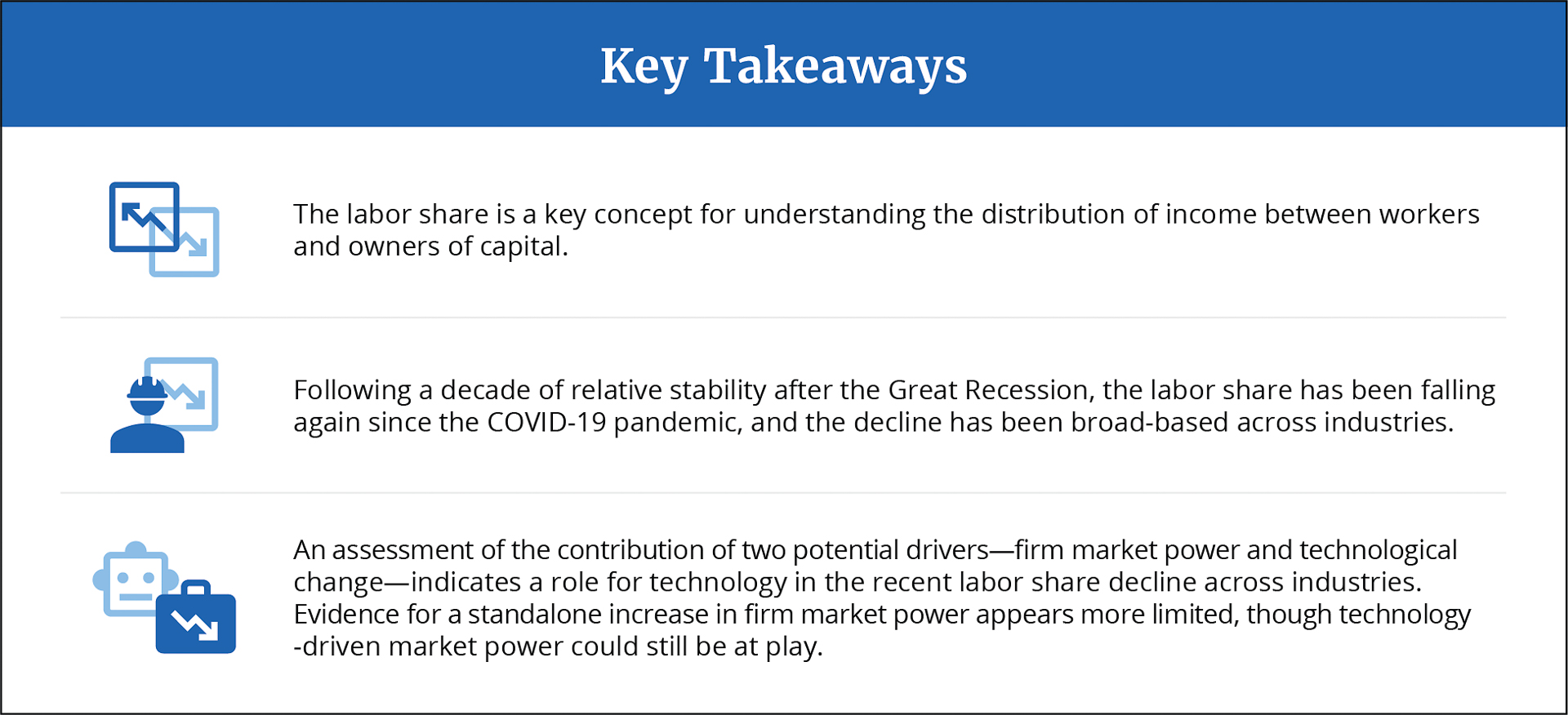
The labor share—the portion of an economy’s total income that is paid to workers in wages and benefits—is a key concept for understanding how economic output is distributed between workers and the owners of capital (such as shareholders and business owners). For much of the twentieth century, the labor share was remarkably stable, and this stylized fact became a defining feature of widely used macroeconomic growth models.
In more recent decades, however, the labor share has declined noticeably across both developed and developing economies.1 When the labor share falls, a smaller portion of total income goes toward worker compensation, while a larger share flows to corporate profits and capital owners. Because capital ownership is spread much more unevenly across households than wages, a shift in income toward capital can widen income inequality.
Sign up for Research Department Updates.
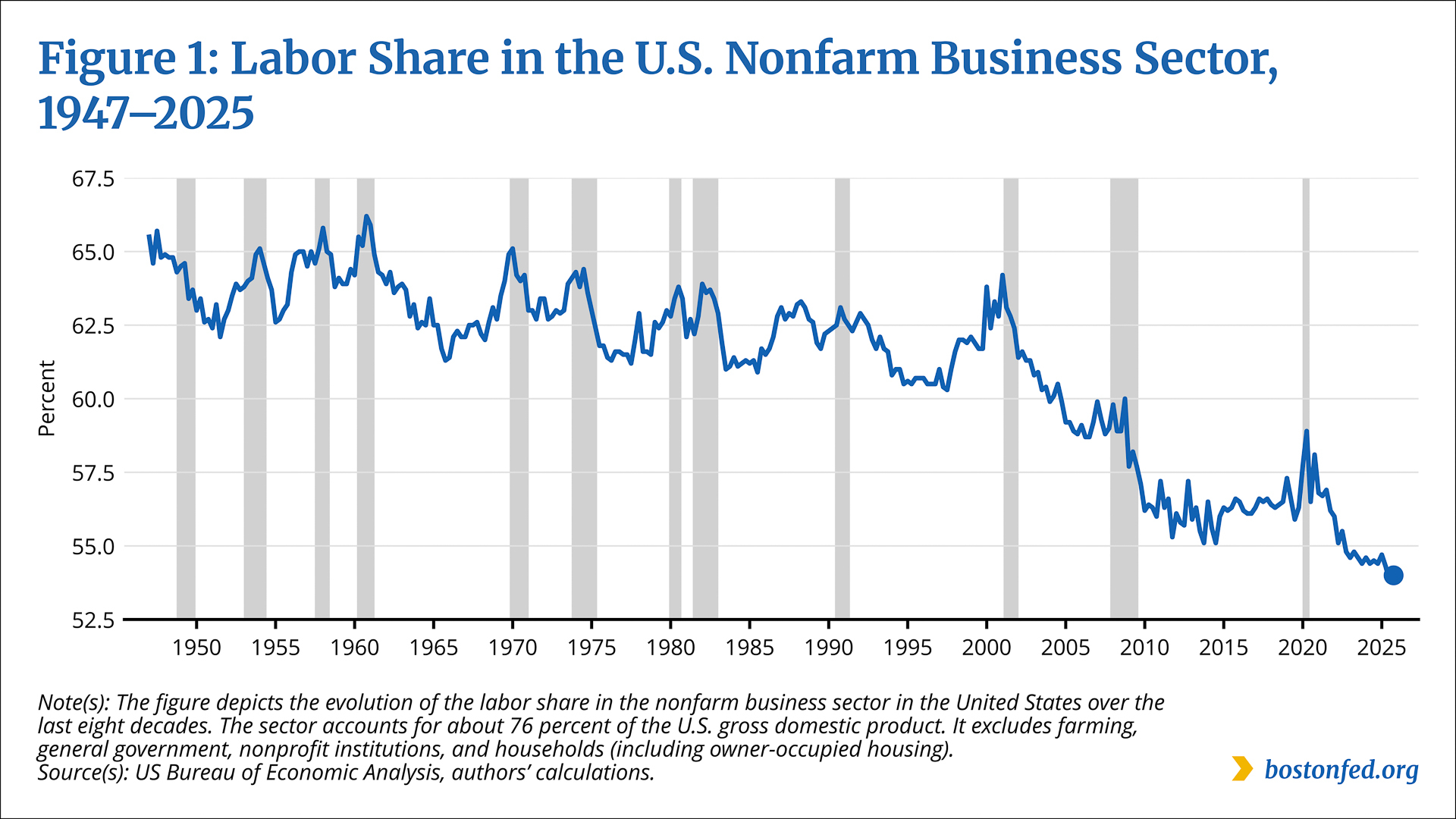
Figure 1 depicts the evolution of the labor share in the nonfarm business sector in the United States.2 After nearly five decades of relative stability, the labor share declined sharply from the late 1990s to the mid-2000s. It was then relatively stable for a decade after the Great Recession. However, it has been falling again since the COVID-19 pandemic. This recent period of decline is the focus of this brief.
Federal Reserve Bank of Boston
We assess two potential explanations for this recent decline: rising firm market power and technological change. Our findings suggest that technological change plays some role in explaining the post-pandemic decline across industries, whereas evidence for a pure increase in market power is more limited. However, an increase in market power resulting from technological change could still be at work.
Industry-wide Scope of the Decline and Two Potential Explanations
Measuring the labor share in practice is not straightforward. Challenges include determining how proprietors’ income3 is allocated between labor and capital, how to treat capital depreciation, and how to define income (national versus domestic), among others. Nevertheless, the decline in the labor share in the post–pandemic period appears robust across different measures and definitions.4
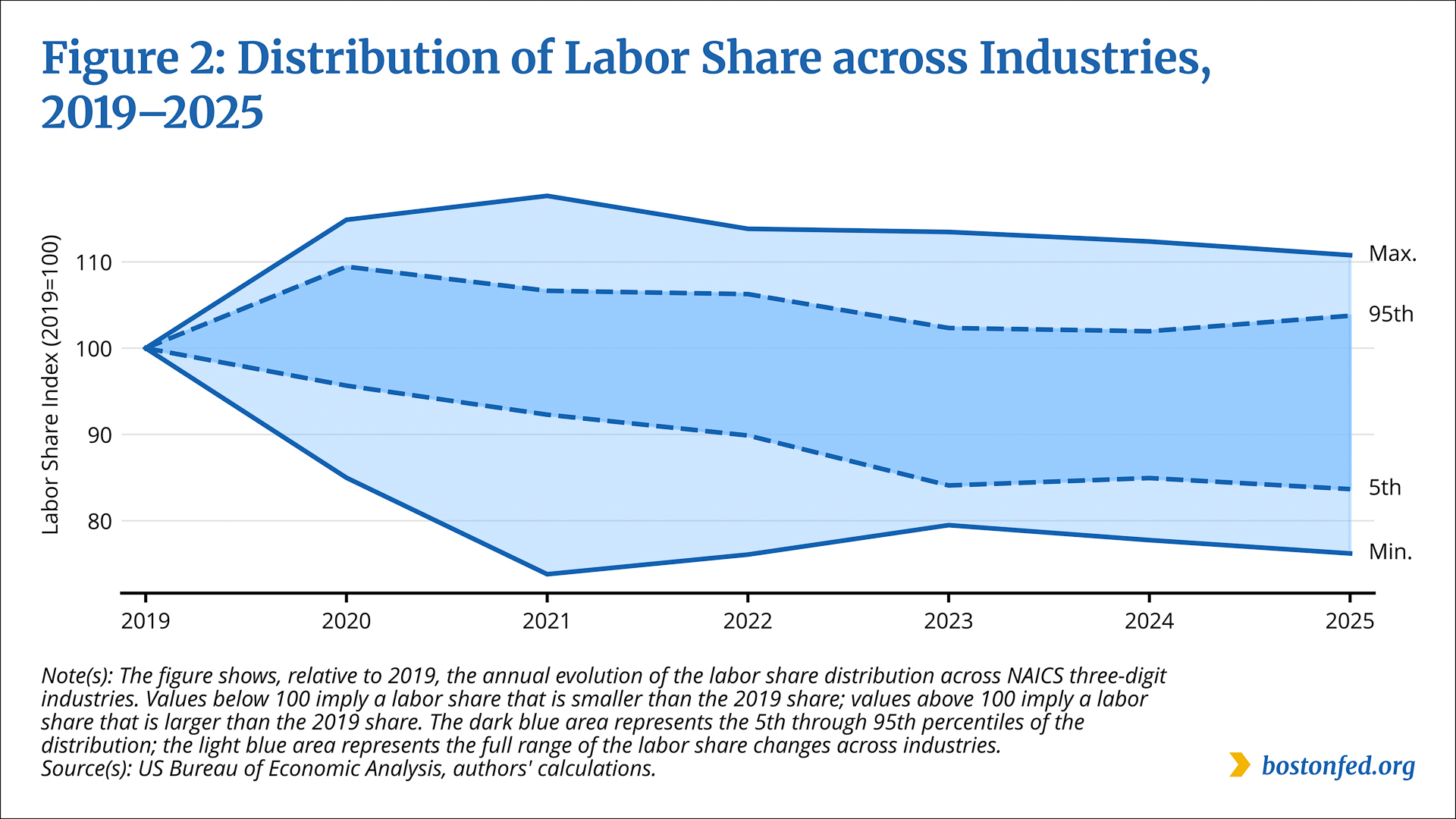
The decline also has been broad-based across many industries. Figure 2 shows the annual evolution of the labor share distribution across North American Industry Classification System (NAICS) three-digit industries from 2019 to 2025. For each industry, the labor share is measured as the portion of the industry’s nominal value-added5 that employees receive as compensation, according to data from the U.S. Bureau of Economic Analysis (BEA). For most industries, the labor share declined over this period. Specifically, the industries with a declining labor share account for 82 percent of total nominal value-added across the industries in our sample.6
Federal Reserve Bank of Boston
The vast academic literature studying the longer-term decline in the labor share proposes many explanations, including technological change, globalization, increased firm market power, and workers’ declining bargaining power.7 Some of these factors could still be driving the more recent, post-pandemic decline.
Here, we consider the potential role of two of these factors in explaining changes in the labor share: a rise in firm market power and technological change. We focus on these two factors because since the COVID-19 pandemic, inflation has been running high and firm profitability has been elevated. This pattern could reflect firms exercising greater market power (that is, charging higher markups), which would boost prices and raise inflation, at least temporarily. At the same time, labor productivity (output per hour worked) has accelerated, which could reflect firms adopting new technologies such as digital infrastructure, advanced software, automation, and AI tools.
The labor share can be decomposed as compensation per hour times total hours worked, divided by the price per unit of output times total output. Because labor productivity is total output divided by total hours worked, the labor share can be defined as nominal compensation per hour divided by the product of price per unit of output and labor productivity.8
Our approach involves examining the cross-industry relationships among labor share, prices, and labor productivity. Given the labor share definition, however, simply comparing cross-industry variation in the labor share with cross-industry variation in prices doesn’t necessarily isolate the potential role of market power in labor share movements. The same holds for inferring the role of technology from cross-industry variation in the labor share compared with cross-industry variation in labor productivity. This is because each of the two factors—market power and technology—can affect prices and labor productivity simultaneously. Most notably, technological improvement could boost labor productivity while slowing price growth. This slowdown would cloud the effect of an increase in market power on prices and the labor share. Correspondingly, industries in which firms exercise increased market power should see greater slowdowns in demand for their products, all else being equal. Such a slowdown could reduce labor productivity if smaller-scale operations are less efficient, clouding the effect of technological improvement on labor productivity and the labor share.9
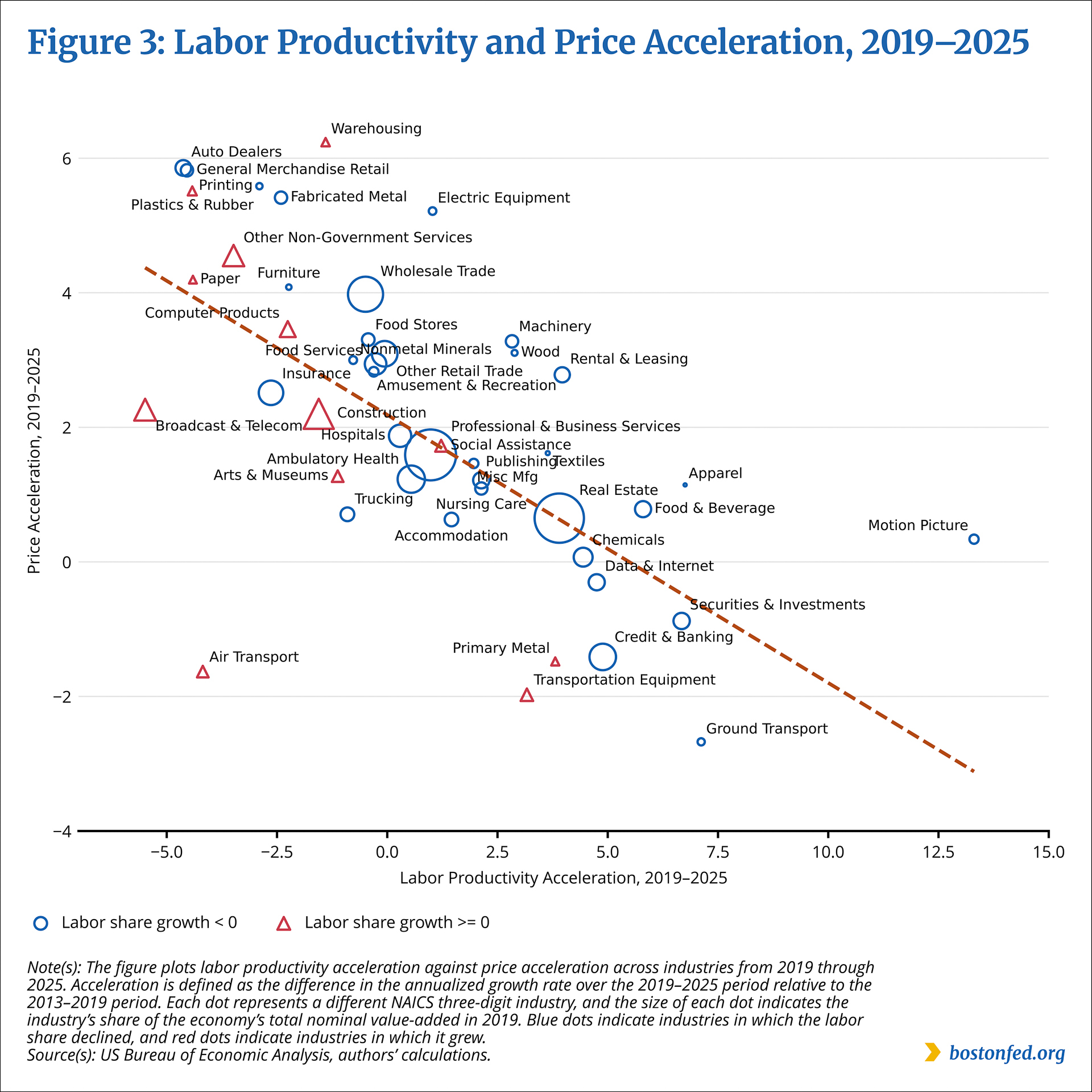
Indeed, over the 2019–2025 period, prices and labor productivity were strongly—and negatively—related. Figure 3 plots the acceleration in labor productivity against the acceleration in prices across industries over that period. Acceleration is defined as the difference in the annualized growth rate over the 2019–2025 period relative to the 2013–2019 period. By considering acceleration in those variables, we account for preexisting differences in the rates of price growth and labor productivity growth across industries. We use the 2013–2019 period for benchmarking because the labor share was relatively stable over that period, at least in the aggregate.
Federal Reserve Bank of Boston
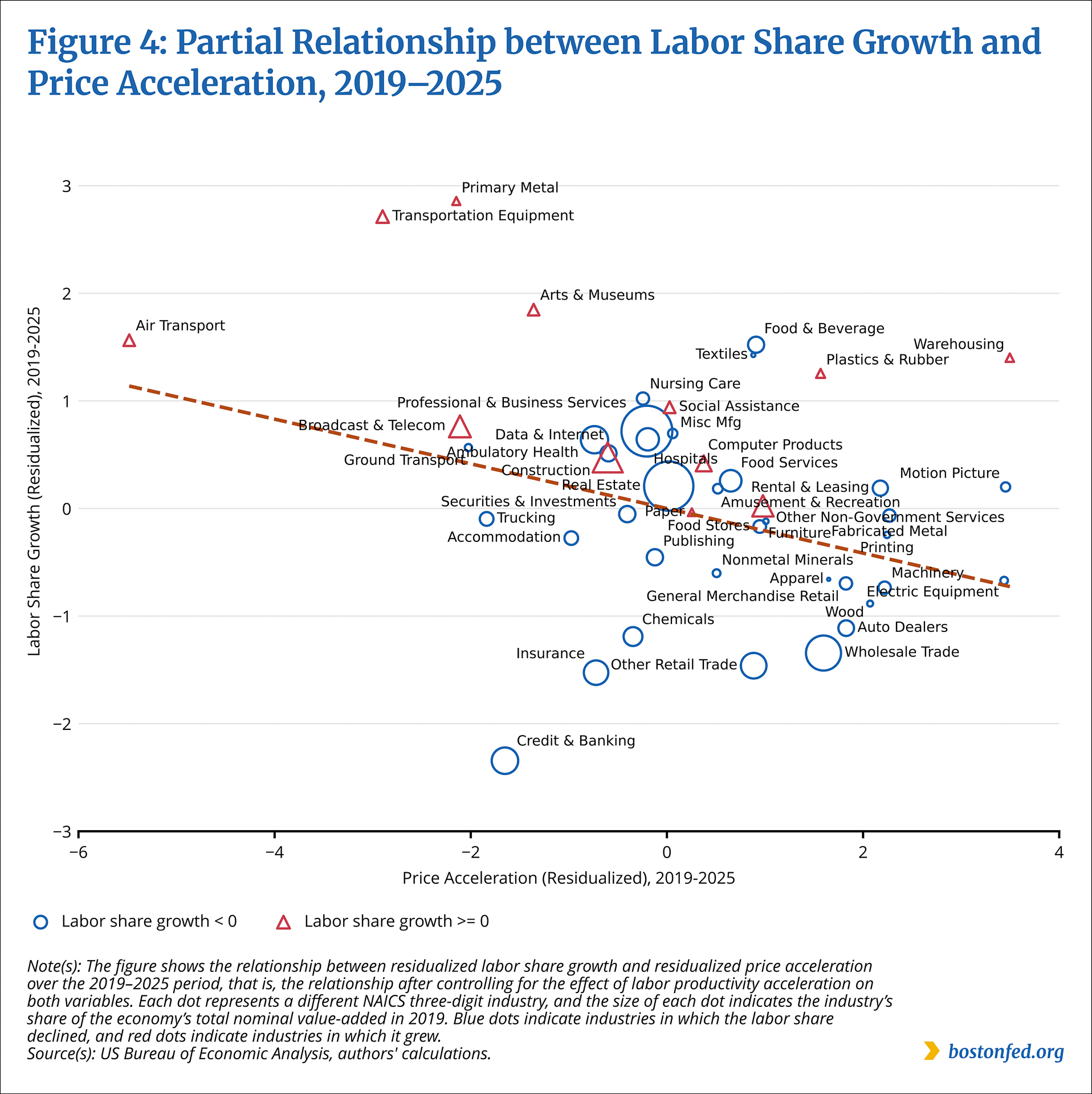
Each dot in the figure represents a different NAICS three-digit industry, and the size of each dot indicates the industry’s share of the economy’s total nominal value-added in 2019. We color-code each industry by the direction of its labor share change: Blue dots indicate industries in which the labor share declined, and red dots indicate industries in which it grew. The figure shows that industries in which labor productivity accelerated more also tended to be the ones in which prices accelerated less, and vice versa.
Given the strong negative correlation between prices and labor productivity, we next consider labor share growth’s partial relationships with price acceleration and with labor productivity acceleration. With this approach, we partial out—that is, control for—the confounding effects of labor productivity when examining the cross-industry relationship between labor share growth and price acceleration and the confounding effects of prices when examining the cross-industry relationship between labor share growth and labor productivity. This enables us to better isolate the potential impact of market power or technological change on the labor share. Price acceleration and labor productivity acceleration—the two variables depicted in Figure 3—together account for roughly 50 percent of the industry variation in labor share growth over the 2019–2025 period.10
A Pure Market Power Hypothesis
Under a pure market power hypothesis, higher markups by firms lead to higher prices, which erode real hourly compensation relative to labor productivity, reducing the labor share. If increased firm market power were the primary driver of the labor share decline, industries with a larger decline in the labor share would experience greater price acceleration. Here, we use price acceleration (after partialling out labor productivity effects) as a proxy for increased market power in an industry—albeit an imperfect proxy, since other factors likely also affected this acceleration.
With this caveat in mind, we show, in Figure 4, the partial relationship between labor share growth and price acceleration over the 2019–2025 period. The relationship is mildly negative, suggesting a potential role for increased market power in the post-pandemic labor share decline across industries.11 We also find that in industries in which real compensation per hour accelerated less, the labor share tended to decline more, which is also consistent with increased market power potentially playing a role in the labor share decline.
Federal Reserve Bank of Boston
Even though the relationship is relatively weak, it does not necessarily indicate a small role for market power because, as noted earlier, price acceleration is only an approximation for increased markups. As a result, measurement error could attenuate the relationship.
A Technological Change Hypothesis
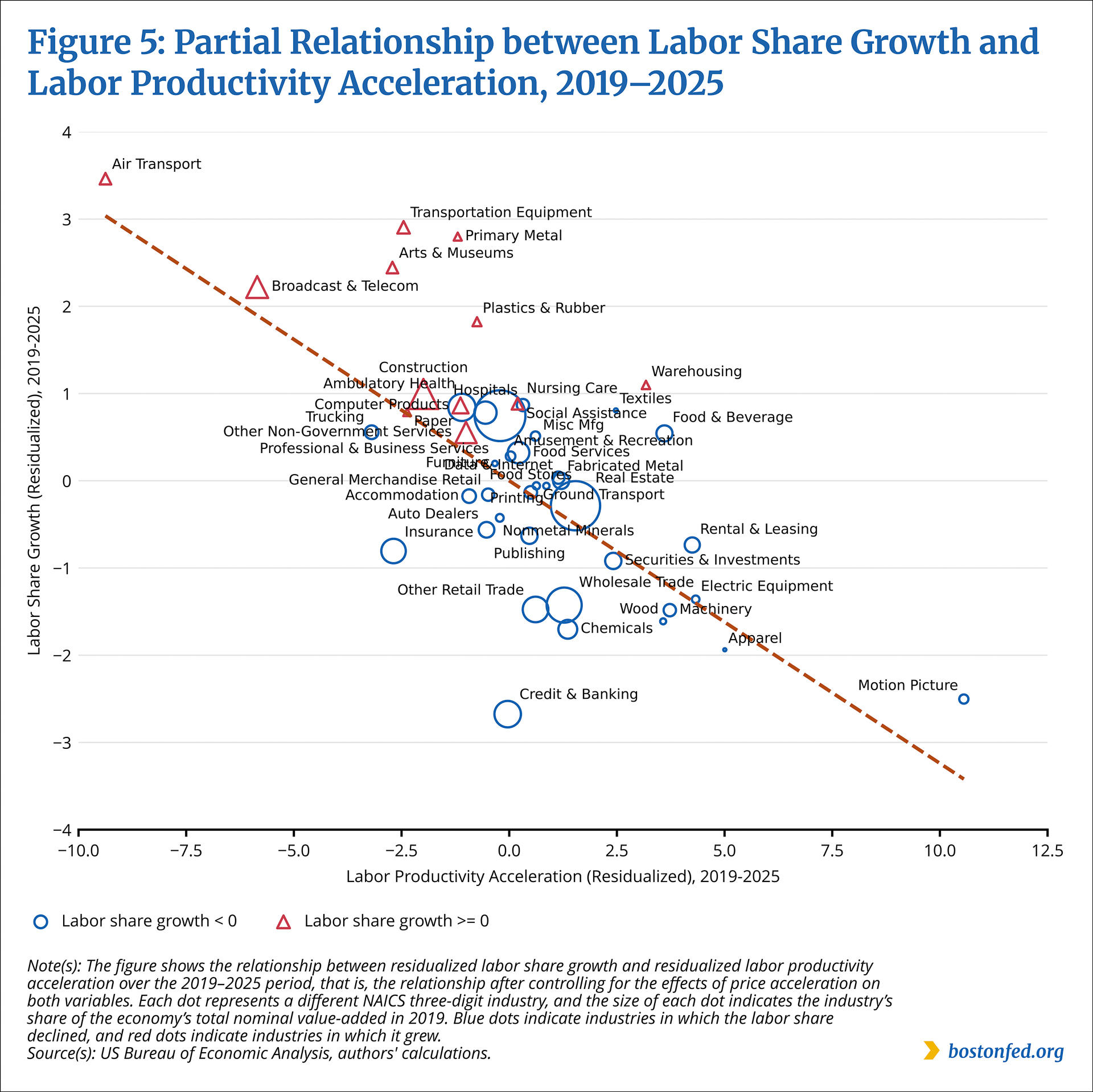
While a pure market power hypothesis cannot be ruled out as an explanation for changes in the labor share across industries, the strong negative correlation between price acceleration and labor productivity acceleration discussed earlier suggests that technology may be playing a more important role in driving those changes. As we noted earlier, the post-pandemic period has been characterized by a pickup in labor productivity. Here, we take an acceleration in labor productivity (after partialling out price effects) as a proxy for technological progress, with the caveat that other industry-specific factors also could be driving the acceleration.
Figure 5 shows the partial relationship between labor share growth and labor productivity acceleration over the 2019–2025 period. The relationship is strongly negative: Industries with greater labor productivity acceleration also tended to experience a larger decline in the labor share.
Federal Reserve Bank of Boston
While the figure suggests that technology has played a role in driving the decline in labor share, the underlying economic mechanism and the ultimate long-run impact depend on the nature of the technological change. It can be either capital-biased—favoring capital owners over workers—or neutral with respect to the factors of production.
When productivity gains are driven by capital-augmenting technology—such as automation, advanced software, or artificial intelligence (AI)—capital’s role in production grows relative to labor’s role. While workers become more productive, their increased productivity partly reflects a greater contribution from the capital equipment or technology that they use. Consequently, a larger share of income flows to capital owners, reducing the labor share.12
In theory, capital-biased technological change can explain the decline in the labor share independently of market power. In this context, the negative relationship between the acceleration in prices and labor productivity depicted in Figure 3 would result from technological change improving labor productivity and applying downward pressure on prices, all else being equal.
Still, despite the negative correlation between prices and productivity, technology gains may not have fully passed through into prices, and while capital-biased technological change does not require higher markups, we cannot rule out a concurrent markup effect. As we discuss later, adjusting to technological change can entail temporarily higher markups. Also, in practice, because capital-biased technologies involve substantial fixed costs, they favor adoption by larger firms that can charge higher markups. If so, the decline in the labor share could be a combination of technological change and higher markups. It is important to note, however, that greater market power in this scenario is a byproduct of technological change and thus differs from the independent (that is, orthogonal to labor productivity) pure market power hypothesis we presented earlier.
By contrast, if the labor productivity acceleration stems from neutral technological change, the negative correlation shown in Figure 5 can be explained only if the change simultaneously generates higher markups. A neutral technological change makes both capital and labor proportionately more productive, leaving the labor share unchanged in the long run. However, in the short to medium term, even a neutral technological change can cause a transitional decline in the labor share. This occurs because firms initially do not fully pass through productivity gains into prices, allowing firms to enjoy temporarily higher profits and increased market power. It takes time for new firms to enter profitable markets, compete on price, and eventually bring markups back down—and the labor share back up—to normal levels. Indeed, a large empirical literature documents how adjustment to technological change can take considerable time and entail higher transitional markups.13
In fact, this transitional markup effect may become permanent if, as noted earlier, technological change systematically favors larger firms, enabling them to capture greater market share. Since larger firms typically charge higher markups, market power would increase at the aggregate level, and the decline in the labor share would not reverse even after the adjustment process ends. This discussion highlights how the distinction between technology and market power in driving changes in the labor share can, in practice, be somewhat artificial.
Implications for the Aggregate Labor Share
Overall, our findings suggest some role for technological change in explaining the post-pandemic decline in the labor share across industries. Evidence for a pure increase in market power appears to be more limited; however, this finding could be the result of attenuation bias due to measurement error. Moreover, an increase in market power during this period may reflect strong demand, supported by several factors such as fiscal policy and high equity valuations.14 To the extent that these demand effects were mostly common across industries, cross-industry relationships will not capture them. Ultimately, even if a pure increase in market power may not be the ultimate source of the labor share decline, an increase in markups resulting from technological change could still be at work, in both the short and the long run.
Furthermore, caution must be exercised when extrapolating these cross-industry findings to the aggregate economy—in particular, before concluding that technological change is a significant driver of the aggregate labor share decline—for at least three reasons.
First, technological change may induce labor reallocation across industries in a direction that mutes the impact of technology on the aggregate labor share. This would happen if labor were reallocated away from industries seeing faster technological change toward industries with slower technological change.15 Indeed, we find that industries that exhibited less acceleration in labor productivity were also the ones in which the acceleration of hours worked was greater, and vice versa. This negative correlation between labor productivity and hours worked could be consistent with labor reallocation effects. At this point, though, this relationship is not particularly strong, and it is thus unclear whether it would be sufficient to significantly mute the impact of technology on the aggregate labor share decline. Nevertheless, the reallocation process could be ongoing.
Second, technology changes may induce a reallocation of nominal value-added across industries. The aggregate labor share is the weighted average of each industry’s labor share, with the weight given by the industry’s share in the economy’s total nominal value-added. With technological change, these weights could shift toward industries experiencing slower technological change.16 One reason for this weight shift is a change in industries’ relative prices. Indeed, as we showed in Figure 3, industries seeing faster technological change—proxied by labor productivity—also tended to be the ones in which prices accelerated less, and vice versa. These relative price changes would increase the weight of industries experiencing a smaller relative decline in the labor share and thus reduce the impact of technological improvement on the aggregate labor share decline.
Finally, our brief considers only two potential drivers of the post-pandemic labor share decline. Other factors that we have not considered could also be at play, such as a decline in workers’ wage-bargaining power. Recent research shows that workers are willing to forgo some wage gains to avoid negotiation conflicts with their employers.17 This conflict avoidance could be on the rise given the potential threat of labor displacement from AI and other recent technological gains.
Endnotes
- Although the specific timing can vary by country and by how the labor share is measured, Karabarbounis (2024) notes that the world labor share has declined by about 6 percentage points since 1980.
- The nonfarm business sector comprises about 76 percent of the U.S. economy’s value-added. It excludes farming, general government, nonprofit institutions, and households (including owner-occupied housing). See “Productivity and Costs First Quarter 2026, Preliminary,” U.S. Bureau of Labor Statistics news release, May 7, 2026.
- In the U.S. Bureau of Economic Analysis (BEA) National Income and Product Accounts (NIPAs), proprietors' income measures the current-production income of sole proprietorships, partnerships, and tax-exempt cooperatives.
- In particular, the recent decline in the labor share is also prominent in the nonfinancial corporate sector, where the split of proprietors’ income between labor and capital is not an issue. See also Karabarbounis (2024).
- Nominal value-added of an industry is the value of its sales minus intermediate inputs used in production. Intermediate inputs include energy, raw materials, semi-finished goods, and purchased services used in the production process.
- The industries shown in the figure constitute 95.74 percent of the economy’s total nominal value-added output in 2019. The excluded industries are agriculture, mining, utilities, and petroleum and coal products manufacturing.
- For a review of this literature, see Grossmann and Oberfield (2022).
- In other words, defining W as nominal compensation per hour, H as total hours worked, P as the price per unit of output, and Y as total output, the labor share is equal to (W*H)/(P*Y). This can be rewritten as nominal compensation per hour divided by the product of price per unit of output and labor productivity, that is, W/[P*(Y/H)].
- Still, it is important to note that evidence supporting the presence of increasing returns to scale at the industry level is, at best, mixed. See Basu and Fernald 1997).
- This 50 percent refers to the R-squared of an unweighted regression of labor share growth on price and labor productivity acceleration over the 2019–2025 period across three-digit industries.
- When the effect of labor productivity acceleration is not partialled out, the relationship between labor force growth and price acceleration is weakly positive.
- A decrease in the labor share after a capital-biased technological improvement requires that capital and labor are substitutable, rather than complementary, in production. See Karabarbounis (2024).
- See, for example, Basu, Fernald, and Kimball (2006).
- While we show weighted lines of fit in all the scatterplots, the relationships are essentially unchanged when we consider unweighted versions. This implies that the relationships that we examine in this brief are not driven by a handful of large industries, that they instead reflect broader trends across three-digit industries.
- Labor can reallocate from industries that are benefitting more from the technological change to industries that are benefitting less when consumers want to keep the share of goods and services they purchase relatively constant—in other words, when the goods and services that different industries produce are not close substitutes. This point was originally made in Baumol (1967). See also Acemoglu and Guerrieri (2008).
- See Acemoglu and Guerrieri (2008).
- See Guerreiro et al. (2026).
References
Acemoglu, Daron, and Veronica Guerrieri. 2008. “Capital Deepening and Nonbalanced Economic Growth.” Journal of Political Economy 116(3): 467–498.
Basu, Susanto, and John G. Fernald. 1997. “Returns to Scale in U.S. Production: Estimates and Implications.” Journal of Political Economy 105(2): 249–283.
Basu, Susanto, John G. Fernald, and Miles S. Kimball. 2006, “Are Technology Improvements Contractionary?” American Economic Review 96(5): 1418–1448.
Baumol, William J. 1967. “Macroeconomics of Unbalanced Growth: The Anatomy of Urban Crisis.” American Economic Review 57(3): 415–426.
Grossmann, Gene M., and Ezra Oberfield. 2022. “The Elusive Explanation for the Declining Labor Share.” Annual Review of Economics 14: 93–124.
Guerreiro, Joao, Jonathon Hazell, Chen Lian, and Christina Patterson. 2026. “Why Do Workers Dislike Inflation? Wage Erosion and Conflict Costs.” Econometrica 94(5): 1651–1684.
Kaldor, Nicholas. 1957. “A Model of Economic Growth.” The Economic Journal 67(268): 591–624.
Karabarbounis, Loukas. 2024. “Perspectives on the Labor Share.” Journal of Economic Perspectives 38(2): 107–136.

 About the Authors
Vaishali Garga,
Federal Reserve Bank of Boston
Vaishali Garga is a principal economist in the Federal Reserve Bank of Boston Research Department.
Email: Vaishali.Garga@bos.frb.org
Giovanni P. Olivei,
Federal Reserve Bank of Boston
Giovanni P. Olivei is a senior vice president and deputy director of research at the Federal Reserve Bank of Boston.
Email: Giovanni.Olivei@bos.frb.org
Resources
Site Topics
Keywords
- labor share ,
- labor productivity ,
- Artificial Intelligence ,
- income distribution
JEL Codes
- E31 ,
- E52 ,
- E37
Citation
Garga, Vaishali, and Giovanni P. Olivei. 2026. “Market Power, Technological Change, and the Post-pandemic Labor Share Decline.” Federal Reserve Bank of Boston Current Policy Perspectives 26-11.