Can New England’s diminished manufacturing sector see growth again? 
Manufacturing, once a regional economic pillar, looks to expand following a painful decline

Steve Osemwenkhae/Federal Reserve Bank of Boston


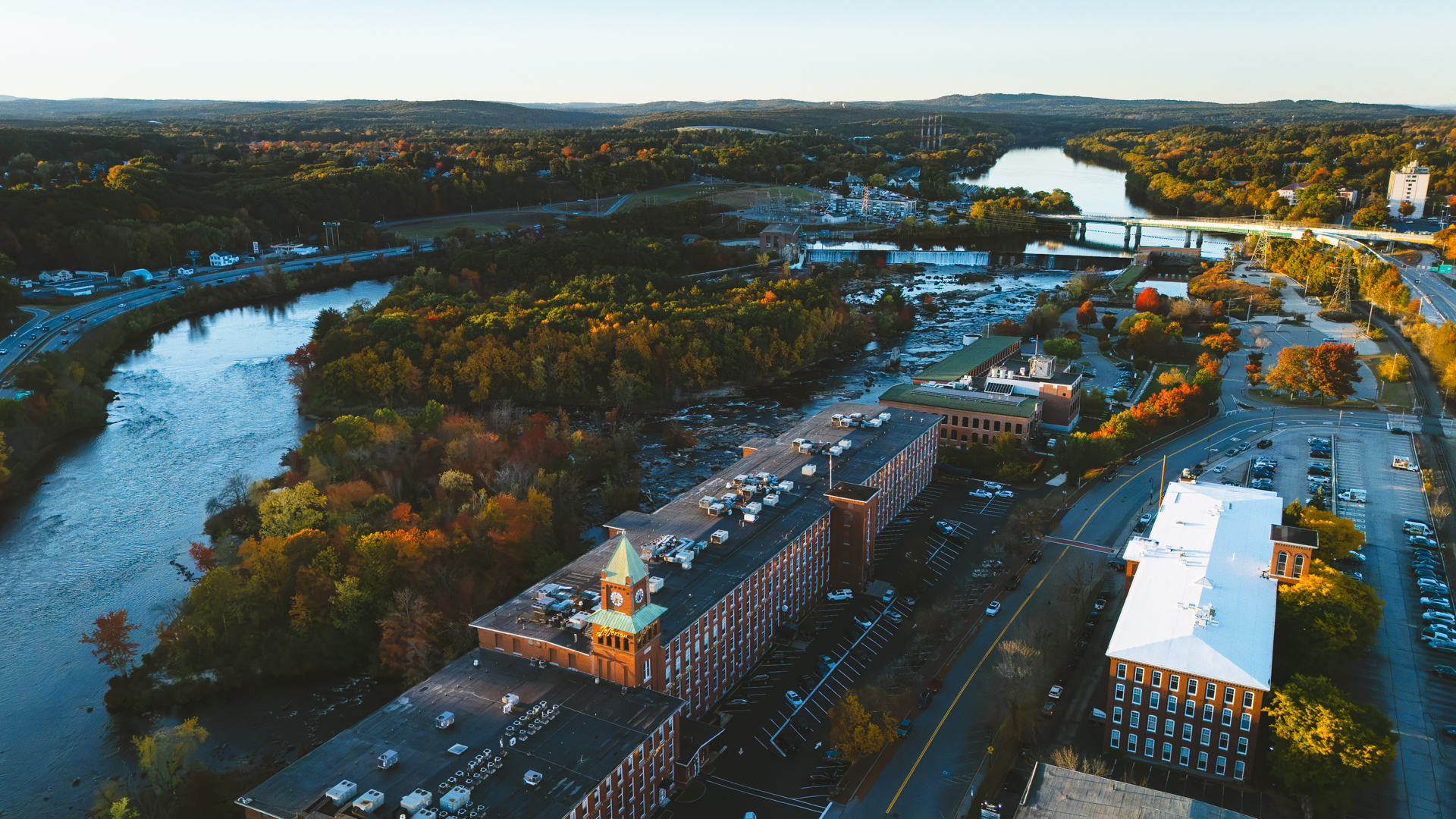
The historic manufacturing city of Manchester, New Hampshire, was once the village of Derryfield, which was founded in 1751 near the Amoskeag Falls on the Merrimack River.
The falls drop 50 feet in a quarter of a mile, giving them a hydraulic might that industrialist Samuel Blodget imagined could power a factory complex. He believed Derryfield could be “the Manchester of America,” a reference to the English industrial center.
In 1810, locals renamed their village Manchester in Blodget’s honor. Then in the coming decades, they built the largest textile mill in the world. At its peak, the Amoskeag Manufacturing Company employed 17,000 people in 30 buildings covering 6 million square feet. But on Christmas Eve in 1935, the company abruptly closed for good.
This shutdown story would be repeated for decades in some form at manufacturers around New England. Manufacturing was an economic pillar of the region, and its decline has been painful.
The Amoskeag Falls in Manchester, New Hampshire, powered the Amoskeag Manufacturing Company, which was once the largest textile mill in world. But the company closed abruptly in 1935. Steve Osemwenkhae/ Federal Reserve Bank of Boston
The long fall is linked to several factors, primarily cheaper labor, first in the south, and then overseas. In just 20 years, between 1990 and 2010, New England lost nearly half (47.3%) of its manufacturing jobs, which fell from 1,129,100 to 595,400, according to data from the U.S. Bureau of Labor Statistics (or BLS).
But regional manufacturing has held relatively steady since. Between January 2010 and September 2026, New England manufacturing jobs fell 4.1%, to about 571,200, still a sizable workforce. Manufacturing jobs accounted for 7.5% of all nonfarm employment in New England as of September, according to BLS data.
Slight declines or slight growth (depending on the state) certainly beats rapid job loss. But after years of that, an obvious question remains: Is major manufacturing growth still possible in New England?
New England has disadvantages – and hope
The region comes with disadvantages that don’t support manufacturing expansion, including high labor and energy costs and challenging demographics (e.g., an aging population and low fertility). Manufacturers struggle to find enough workers just to maintain the status quo.
They also report ignorance or negative views about the sector. They’ve responded with skills-training programs and awareness campaigns that reach children as young as 5.
There’s also hope in “advanced manufacturing,” which is the evolution of manufacturing to high-tech and usually automated production methods and machines. It’s increasing efficiency, opening up manufacturing to a broader range of workers, and helping create new jobs in new industries. It’s not nearly everywhere yet. But it is inside Manchester’s former Amoskeag Manufacturing Company.
Dr. Jennifer MacDonald works at the old mill yard there, in a space where a machine shop once serviced some of the company’s thousands of looms. She’s the chief operating officer at ARMI (the Advanced Regenerative Manufacturing Institute), which is leading efforts to create a global center here for “biofabrication,” the manufacture of human tissue and organs.
The technology is futuristic and complex, and livers and lungs are a much different product than the 50 miles of cloth the Amoskeag mills churned out each hour. But MacDonald said Manchester’s lost manufacturers left behind more than brick buildings.
“The engineering and manufacturing prowess was already here,” she said. “Now, it is applied to the life sciences and is thriving and growing.”


 View Gallery


2 images

John Belding was an engineer at an auto parts manufacturer in Maine before he became the director of the Advanced Manufacturing Center at the University of Maine. He also sees potential for growth. To him, promise is found in the state’s abundant water, ocean access, and vast forests, which could support new manufacturing in areas like biofuels and plastics.
But how can Maine get businesses to remote areas that lack updated infrastructure, amenities, and services the workforce would expect? And will enough come to form the critical mass that attracts more companies and more workers? In the meantime, can the region retain the manufacturing workforce it has?
Better efficiency and a focus on the future are critical, Belding said.
“Preserving those jobs, what we can right now, is vastly important,” he said. “And if we don't make improvements, we're never going to attract new ones either.”
New England’s rivers, streams were the foundation of its manufacturing power
New England owes much of its early manufacturing prominence to its geography. Companies built mills to harness energy from the countless fast-running rivers and streams that flow down its hills and mountains to the ocean.
No regional database lists every mill, but a survey by Preservation Connecticut offers a glimpse of their density: It’s documented 1,535 mills in that state for possible rehabilitation or reuse.
New England’s manufacturers had long moved past water-powered mills by the early 1990s, when the most recent prolonged decline in manufacturing jobs began.
At that time, the end of the Cold War meant a painful pullback on defense spending, a mainstay of New England manufacturing. Connecticut and Massachusetts are both in the top 10 of defense contract spending by state, and New England’s largest manufacturers are defense contractors.
Defense contractor RTX (which includes Pratt & Whitney, Collins Aerospace, and Raytheon) has about 33,000 employees in New England, including 16,300 in Connecticut and 12,100 in Massachusetts. Submarine-maker General Dynamics Electric Boat has about 28,000 employees total in Connecticut and Rhode Island.
But a few years after the 1990s defense cuts, Electric Boat’s employee headcount plummeted to around 8,000, according to Chief Financial Officer Rocco Cavalieri.
Around that time, U.S. manufacturers were also being hit by the so-called China Shock, which accelerated in 2001 after China joined the World Trade Organization. The WTO’s limits on tariffs against member countries meant prices on Chinese products suddenly had more certainty. U.S. buyers began importing lots of their cheaper goods, displacing domestic manufacturers.
Between 1990 and 2009, manufacturing jobs dropped sharply in every New England state, according to graphs of BLS data on the Federal Reserve Economic Data (or FRED) website. Then, the trend lines flattened out at the end of the 2008-2009 recession.

Federal Reserve Bank of St. Louis
That leveling off was “a win for the economy,” said Lily Fitzgerald, the director of the Center for Advanced Manufacturing in Massachusetts. She added it’s also proof lower costs aren’t everything.
Being close to customers, suppliers, and regulators has major advantages, she said. You can work things out face-to-face or more easily assess a manufacturer’s labor or environmental standards.
That proximity also means avoiding a lot of regulatory and logistical complexity in an age of tariffs and multinational supply chains.
Meanwhile, New England’s concentration of top colleges and high-tech know-how are a unique draw, Fitzgerald said.
“It's really hard to compete with the Massachusetts innovation ecosystem, frankly,” she said.
Expensive energy, older workers, fewer high school seniors
Unfortunately, New England is also known for things that don’t help manufacturers. The six New England states are all in the nation’s top 11 for most expensive industrial electricity rates, according to the U.S. Energy Information Administration.
New England also has the third-highest labor costs per hour (at $54.08) of the nine regional U.S. Census divisions, according to U.S. Bureau of Labor Statistics.
This expensive workforce is also older, with more people approaching retirement. The three northern New England states are the oldest in the country, with Maine (median age, 44.9) just ahead of Vermont (44.4) and New Hampshire (44.1).
Tony Fernandez, the president and CEO of the New Hampshire Manufacturing Extension Partnership, said he sees the region’s age when he meets with local manufacturers.
“I'm in my 70s. A lot of what you see in manufacturing are people who look like me,” Fernandez said. “I'm the young guy in some of these meetings."
He added that’s also partly because companies are paying premium wages to retain workers past traditional retirement age because there’s no one to replace them. That’s related to the region’s problems at the other end of the age spectrum.
The New England states claim six of the country's seven lowest fertility rates (births per 1,000 females ages 15-44), with Vermont’s 41.7 rate the lowest.
John Lewis is executive director of the Manufacturers Association of Maine, the state with the fifth-lowest fertility rate at 46.3. He said there aren’t enough Maine high school graduates to meet manufacturing’s workforce demands. This spring, Maine graduated about 11,600 public high school seniors, and the state hasn’t cracked 14,000 graduates since 2010.
“That’s nowhere near enough,” Lewis said of the 2026 number. “If everybody went into manufacturing, it's nowhere near enough.”
“Survival, baby”
With demographic trends so tough, manufacturers like Connecticut’s Chris Jewell have decided there’s only one thing to do: Whatever it takes. Jewell is CEO of Collins & Jewell Company, a firm in Bozrah that his grandfather co-founded in 1946.
Collins & Jewell started out servicing boilers in “old mills that are now condos,” Jewell said. When their customers began moving south, the company’s main business became helping them relocate. And after Asia and Mexico became prime destinations for domestic wire and cable manufacturers, Collins & Jewell switched to moving them outside the U.S.
Then, Collins & Jewell pivoted again. Today, it’s a specialty manufacturer that builds things that help Electric Boat build its submarines, such as the extensive staging it uses when it “butts” its submarine hulls together.
Jewell said the company’s radical shifts in focus are about one thing: “Survival, baby.”
“We understand that we've got to adjust with the times,” he said.


3 images

That includes changing hiring standards to broaden the labor pool. At Collins & Jewell, it’s character first. Then, they train new employees in the skills needed. That’s why the 90-employee firm has counted a former chef, massage therapist, certified nurse’s assistant, and librarian on its payroll.
The Eastern Connecticut Workforce Investment Board, where Jewell is chairperson, has taken the same expansive approach to finding job candidates.
The board created the Eastern CT Manufacturing pipeline, which trains students to work at several regional manufacturers, including Electric Boat. David Allard, the board’s interim president, said the multi-week training programs draw mainly high school students, but also recent high school graduates and people who didn’t finish high school.
They also reach out to veterans, women whose childcare needs are an employment barrier, and those on public assistance looking to re-enter the workforce.
Allard said local manufacturers really can’t overlook anyone. “We have no choice but to activate the entire population,” he said.
Creating a workforce, starting in kindergarten
On a summer morning, what looks like a food truck is parked outside the Penacook Community Center in Concord, New Hampshire. But the truck is labeled the STEM-MoBILE, and instead of tacos or barbeque, it’s brought models of lungs, a knee, and a skull.
University of New Hampshire senior Ava Sanders, a biotechnology major, arrived in the truck. Soon, she’ll invite a group of 5- to 7-year-olds to check it out. But, first, they go inside the center for a presentation.
Sanders tells the children she’s there to teach them about “a brand-new science called biofabrication,” then has them repeat the word in unison. It’s not long before Sanders has them shaking tubes filled with water and sodium alginate – a powder derived from seaweed – then adding a type of salt to make a “hydrogel.” In biofabrication, hydrogels are used to make the “scaffolds” on which the cells grow into the shape of the desired organ.
Sanders patiently but efficiently explains all of this, and the children seem to get it.
“You guys are going to be scientists by the end of this!” says the center’s site director Carol St. Pierre. And that’s kind of the point.

2 images

ARMI projects that establishing a biofabrication center in the Manchester-Nashua area will create 7,000 jobs in that industry over the next several years, though MacDonald thinks that estimate will prove conservative. Either way, people won’t go into biomanufacturing if they don’t know what it is. Enter the STEM-MoBILE.
The traveling science lab is funded by federal dollars and has a mission to spread the word about biofabrication around New Hampshire. Since June 2024, it’s travelled more than 13,600 miles and reached more than 29,000 people.
Sydney Rollins, the STEM-MoBILE project coordinator at UNH, said the audience for the age-adjusted presentations is mostly K-12. But they also reach out to adults as old as retirees, hoping they’ll tell their kids or grandkids about opportunities in a new field.
“We try to just keep the wider lens on it and hope that we're inspiring some people,” Rollins said. “Some of those people are bound to end up in biofabrication.”
Other manufacturing awareness and skills-training efforts in New England are common, if not quite as mobile:
- The Center for Advanced Manufacturing in Massachusetts administers an Advanced Manufacturing Training Grant program that’s developed with local employers to fit their needs.
- The B.O.T. Loft at the UMaine Advanced Manufacturing Center trains technicians and engineers from private companies in new technologies, including factory-authorized robotics training. It also offers summer camps for high schoolers.
- Electric Boat relies on two training programs for its specialized workforce. One is located at Ella T. Grasso Technical High School, near its Groton shipyard, and the other is at the Warwick, Rhode Island, campus of the New England Institute of Technology – about 15 miles north of its Quonset Point facility. High school seniors can enter the programs before they graduate with a guaranteed job at Electric Boat upon completion.

Federal Reserve Bank of Boston First Vice President Karen Pennell visited Ella T. Grasso Technical High School in Groton, Connecticut, in 2025 and heard about the Eastern CT Manufacturing Pipeline. Pennell is standing in front of a submarine "mock-up," which aims to simulate the environment students will be working in as they prepare for a career at nearby Electric Boat. Steve Osemwenkhae/Federal Reserve Bank of Boston
Besides an awareness and skills deficit, manufacturing knows it has perception problems. Fitzgerald said for too long, too many people have ruled out manufacturing as a career option.
“I think that parents, very understandably seeing this massive decline, did not encourage their kids, even if they were tinkerers or thinking about going into the trades,” she said. “We see really strong advantages to manufacturing careers, but we haven't been telling young people that for the last 30 years.”
Allard said manufacturers must promote a more modern image for the sector to grow.
“It is now an industry of choice,” he said. “It’s competitive wages, it's a career pathway, it's little debt, it's high demand, it's job security. It's all of those things. And when we talk about career awareness, that needs to be sold because it's what's truly available.”
What about the three D's of manufacturing?
A cliché about manufacturing is that it can be described by the “three D's” – dark, dull, and dirty (or sub in another negative D-word, like dangerous). The cliché comes up often in discussions about manufacturing, mostly because people think it’s badly outdated. Jewell said it doesn’t apply to his shop.
“It's not the dark, dirty, dingy manufacturing that most people think,” he said. “You know, it's clean, it's green, it's high-tech."
According to its advocates, advanced manufacturing is all those things – plus fast, bright, cutting-edge, precise, and far more efficient. Advanced manufacturing allows companies facing a tight labor pool to do more sophisticated work with fewer people. That helps, even at small companies making prehistoric tools.
Brant & Cochran makes axes in South Portland, Maine. The axe heads are made of U.S. steel, set on hickory handles turned by the Amish, and forged and grinded by a team of blacksmiths that includes company co-founder Mark Ferguson’s daughter. Advanced manufacturing techniques have made the company less wasteful and more profitable, Ferguson said.
He specifically cites metal tools called drifts, which blacksmiths use to shape the “eye” – the hole in the axe head where the wooden handle fits. The company once made its own drifts by hand for several hundred dollars each. There’s no room for error, but errors were made.
So, Brant & Cochran now models the axe heads using computers and 3D printers, accessed through UMaine’s Advanced Manufacturing Center. This allows them to make exact specifications for the drifts with computer-aided design software. The drawings are then sent to the local machine shops that produce them, and Ferguson said it’s made a huge difference.
“Oh, my God, yeah,” he said. “We're not throwing away drifts anymore.”


3 images

Advanced manufacturing can also expand the tight labor pool, according to John Roth, director of the John Olson Advanced Manufacturing Center at UNH. For example, certain manufacturing jobs might at times need exceptional strength, or a steady hand, or excellent eyesight. Now, machines can handle that part of the work, so companies can hire for those roles without requiring hyper-specialization.
“You can be a variety of physical types,” Roth said. “That's where it helps because we do have the oldest population up here.”
The problem with relying on advanced manufacturing tools and technology is that they’re expensive, so many local companies can’t afford them yet. And Lewis, of the Manufacturers Association of Maine, said technologies such as 3D printing are often too slow to produce at the scale needed. He said if Industry 2.0 is about more traditional manufacturing methods, and 3.0 is the automated world of advanced manufacturing, his membership is at around 2.5.
“I'm trying to pull together partners and resources and what have you to try to help our manufacturers, quote-unquote, ‘evolve,’” he said.
In the meantime, any growth in New England will also have to rely on other factors.
“Building on the shoulders of giants,” but not getting stuck in the past
About 98% of manufacturers nationwide are considered small businesses, which have fewer than 500 employees. But most manufacturing employees (nearly 60%) work at companies with 500 or more employees. And there’s often a symbiotic relationship between large and small manufacturers, like the partnership between Collins & Jewell and Electric Boat.
Electric Boat remains in expansion mode because of its long-term government contracts, and it made an ambitious decision to try to add 8,000 jobs this year, Cavalieri said.
He noted that due to attrition the company won’t end up adding exactly that many jobs. But he said he expected the workforce to reach “the low 30(,000)s” in coming years. That’s good news for its partners, as well as ancillary businesses that serve its expanding workforce.
“As we grow, and we have this long, stable trajectory in front of us, we really (take) the whole region along with us,” Cavalieri said.
CEO Drew Matter runs Mikros Technologies, a 100-employee firm in Claremont, N.H. He said manufacturing growth in New England will take two things that can seem at odds – innovation and patience.

2 images

Mikros Technologies makes “cooling solutions” for high-performance microchips and networking switches for data centers. The hardware it manufactures enables heat from these chips and switches to be transferred to a liquid coolant, since they produce so much heat that air doesn’t cool them quickly enough.
The 35-year-old company’s manufacturing process is so exact that when the founder was looking to move the company, he measured local seismic activity to find an area with the fewest vibrations possible. Today, Mikros Technologies and the rest of the sector are trying to grow on literal and metaphorical solid ground.
“You're always kind of building on the shoulders of giants,” Matter said.
He said that means understanding that nothing changes overnight. New products and new processes take time to conceive, implement, and build. He added New England’s manufacturers must remember the past without getting stuck in it.
“I think our ability to bring manufacturing back needs to be forward-looking, not 'How do I make a cheap part cheaper here?,'” he said. “We're actually looking to do different and newer things to be competitive in New England and around the world.”
Media Inquiries?
Contact our media relations team. We connect journalists with Boston Fed economists, researchers, and leadership and a variety of other resources.

 About the Authors
Jay Lindsay is a member of the communications team at the Federal Reserve Bank of Boston.
Email: jay.lindsay@bos.frb.org
Site Topics
Keywords
- Manufacturing ,
- New England ,
- New England region ,
- manufacturing investment ,
- US manufacturing ,
- labor costs ,
- labor market conditions ,
- labor market demographics ,
- population aging ,
- Maine ,
- Vermont ,
- New Hampshire ,
- Rhode Island ,
- Connecticut ,
- Massachusetts