Rising housing costs are creating 'enormous pressure.' What are the challenges and solutions? 
Researchers at Boston Fed’s 70th Economic Conference discuss ways to increase supply, productivity

Steve Osemwenkhae/Federal Reserve Bank of Boston


Rising rents and home prices over the last five years are creating “enormous pressure” on household budgets, Federal Reserve Bank of Boston President Susan M. Collins said Friday.
What can be done to relieve it? And how are zoning regulations and construction productivity impacting supply – and affordability?
Researchers and economists examined these and other questions at the Boston Fed’s 70th Economic Conference, which was held at the Bank on Nov. 13 – 14. The event was titled, “Residential Realities: Understanding Challenges and Considering Solutions in the U.S. Housing Market.”
Collins said in her opening remarks that the costs and limited availability of housing constantly come up in her discussions with business and community leaders around New England.
Boston Fed President Susan M. Collins speaks at the Bank's 70th Economic Research Conference. Steve Osemwenkhae/Federal Reserve Bank of Boston
She noted the Federal Reserve doesn’t make housing policy, but it keeps a close eye on the housing market because it’s critical to the economy. For example, Collins said limited housing availability and affordability significantly impacts businesses’ ability to find workers.
The housing sector is also particularly sensitive to interest rates, she said, and that means the Fed’s monetary policy can affect things like mortgage rates and new residential investments.
There’s no “silver bullet” that will solve the housing market’s many challenges, she added.
“It’s going to take constructive collaboration among many different parties,” Collins said. “Building a shared understanding of the complexities of the housing market is essential – and a fundamental reason for conferences like this one.”
Conference papers and presentations cover a wide range of housing issues
During the first day of the conference, topics included the complexities of measuring the housing shortage, as well as construction and supply issues. The keynote address examined housing developer behavior to determine how local zoning law changes can effectively increase supply.
The second day of the conference focused specifically on the relationship between housing and monetary policy. Researchers discussed how housing relates to the macroeconomy and national business cycles. They also examined new methods policymakers could potentially use to better measure housing inflation.


 View Gallery




3 images

Researchers presented five papers during the conference. A panel session also explored how policy changes could improve housing outcomes in New England.
The paper and panel titles are listed below, and the papers, presentations, and video recordings of each session are available on bostonfed.org:
- “Measuring housing underproduction: why estimates diverge and what a national number can say,” Elena Patel (Brookings Institution)
- “Productivity Growth in Construction: Still Strange and Awful,” Chad Syverson (University of Chicago)
- “Two Decades of Research on Housing Supply: What Have We Learned?” Albert Saiz (Massachusetts Institute of Technology)
- “Why Weren’t the 2022 Rate Hikes Worse?” Konstantin Milbradt (University of California Los Angeles) and David Berger (Duke University)
- “Does the Fed Pay Too Much Attention to Rents?” Gabriel Chodorow-Reich (Harvard University)
- “Local Perspectives on Housing” panel session with Jay Ash (Massachusetts Competitive Partnership), Emily Benson (Bensonwood), Jennifer Hawkins (Avesta Housing), and Jay Tuli (Leader Bank)
Keynote examines relationship between zoning reforms, developer behavior
In her keynote, Harvard economics professor Rebecca Diamond presented new research on how zoning law changes affect developer behavior.
Diamond said communities nationwide are experimenting with changing zoning laws, figuring increasing supply will lower housing costs. But results are playing out differently across the country. For example, in Houston zoning reforms starting in 1998 led to a “boom” in new townhouses, which are relatively cheaper for developers to build.
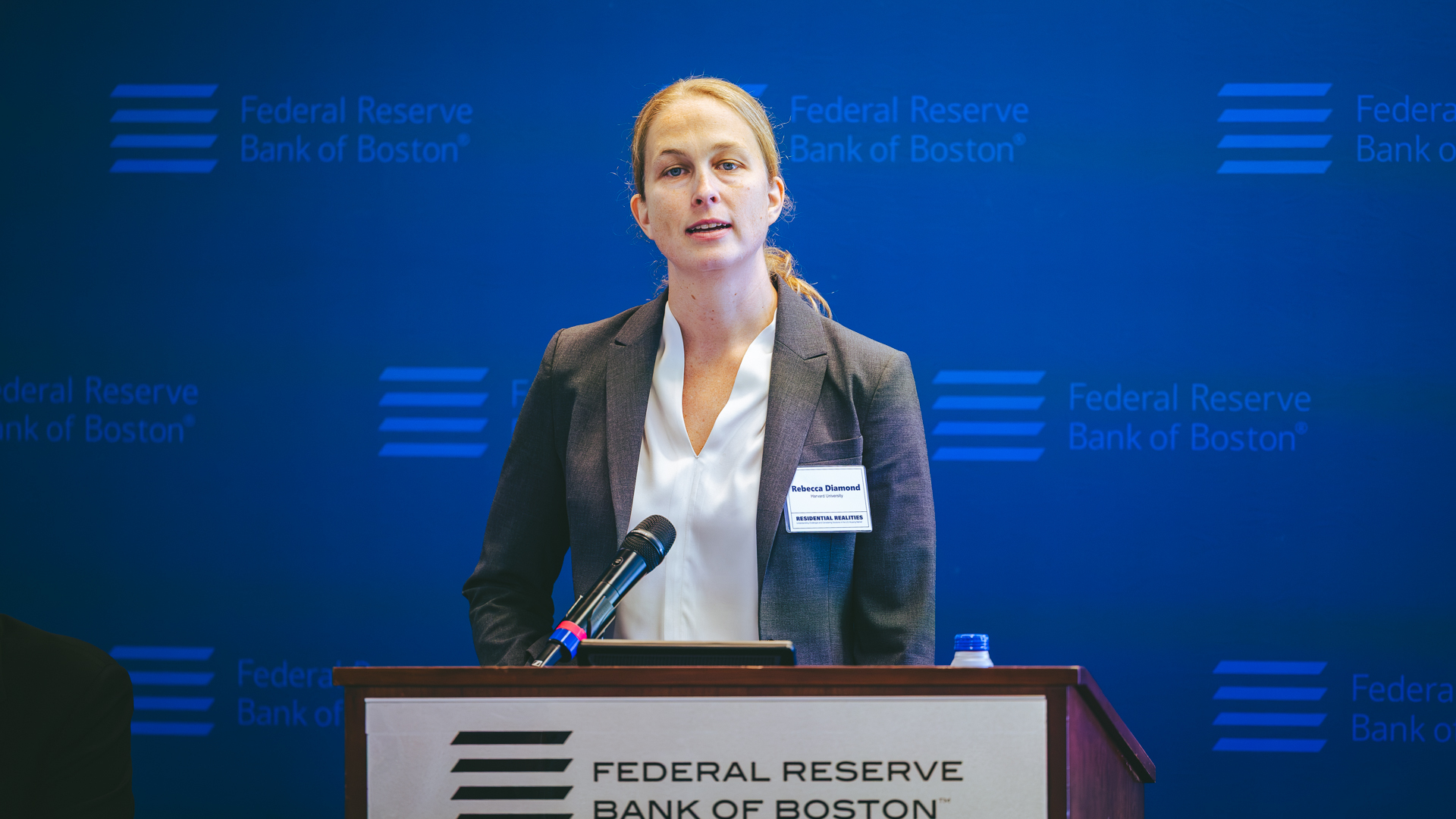
Harvard economics professor Rebecca Diamond delivers the conference keynote address. Michael Konstansky/Federal Reserve Bank of Boston
In contrast, developers didn’t like California’s 2021 “ban” on single-family zoning, which allowed up to four homes on lots zoned for single-family housing. They were deterred by detailed regulations around how long the property owners had to live there, how the lots could be divided, and local rules around project size and design, she said.
In her new paper, Diamond closely analyzed property data in Cook County, Illinois, to better understand how local zoning rules impacted developer decisions to redevelop certain lots.
Diamond and her coauthors used a new model to measure the “development potential” of the lots, weighing variables like the costs of new construction versus renovations. They were also interested in whether certain zoning changes led to building more luxury units, versus affordable ones.
The coauthors’ framework allows them to examine the effects of different proposed policies aimed at increasing Cook County’s housing supply. For example, they found that reducing the cost of the permitting process leads to small increases in supply, while allowing more units per lot can lead to much larger ones.
Diamond said this research approach focusing on developer behavior could be used to study other communities.
“It gives you as a policymaker or researcher a lot more depth of insight into what … can really get built,” she said.
Why has growth in construction productivity dropped?
Chad Syverson, an economics professor at the University of Chicago Booth School of Business, described how construction productivity (including in housing construction) declined from 1970 – 2025 while the overall economy’s productivity increased. His paper builds upon previous research coauthored with Federal Reserve Bank of Chicago President Austan Goolsbee.
Syverson discussed several potential reasons, including a set of factors he called “the political economy of construction,” which he said typically come from outside the construction industry. Examples include increased building regulations and permitting delays or local objections to certain building projects.

University of Chicago economics professor Chad Syverson discusses why productivity growth in construction has slowed during a Q&A with audience members. Steve Osemwenkhae/Federal Reserve Bank of Boston
He also pointed to the multilayered construction process itself – and a lack of incentives to increase efficiency. He said a construction project often requires many different companies and contractors to work together, including architects, engineers, suppliers, and subcontractors. It’s also common for unforeseen issues to arise while building, which firms can take advantage of for their own financial gain as project timelines increase.
While some say factory-built homes could help increase the housing supply, Syverson said it hasn’t worked yet due to differences between homebuilding and typical manufacturing. For example, he said housing construction happens everywhere, so a factory would need to be near every population center, or transportation costs would be very high. Also, he said some things, like building a foundation, must be done onsite.
If home manufacturing ends up being successful, it will be because making different components offsite improves efficiency, rather than because entire houses are being built in a factory and then transported.
“I’m not saying it’s never going to work,” he said. “I’m saying it hasn’t really been shown to work yet.”
Learn more about the conference participants, read the papers, and watch the presentations on bostonfed.org.
Media Inquiries?
Contact our media relations team. We connect journalists with Boston Fed economists, researchers, and leadership and a variety of other resources.

 About the Authors
Amanda Blanco is a member of the communications team at the Federal Reserve Bank of Boston.
Email: Amanda.Blanco@bos.frb.org
Site Topics
Keywords
- affordable housing crisis ,
- housing costs ,
- housing supply ,
- housing market ,
- housing