The Large Role Small Businesses Play in Employment in New England 


Federal Reserve Bank of Boston

The views expressed herein are solely those of the authors and should not be reported as representing the views of the Federal Reserve Bank of Boston, the principals of the Board of Governors, or the Federal Reserve System.
Small businesses occupy a position of economic and civic importance in New England that is not captured by any single statistic. These firms collectively employ millions of workers, anchor local communities, supply large institutions with goods and services, and are incubators of regional innovation and job growth.
Using data from the US Census Bureau’s Business Dynamics Statistics,1 we quantify the contributions that small businesses made to employment and employment growth in New England during the 2000–2023 period. We also use data from the National Federation of Independent Businesses to look at how New England’s small business owners’ concerns about inflation and insurance availability and costs have intensified and waned since 2000 and how they have aligned with or diverged from the concerns of small business owners across the country.
Sign up for new research and data on the New England economy.
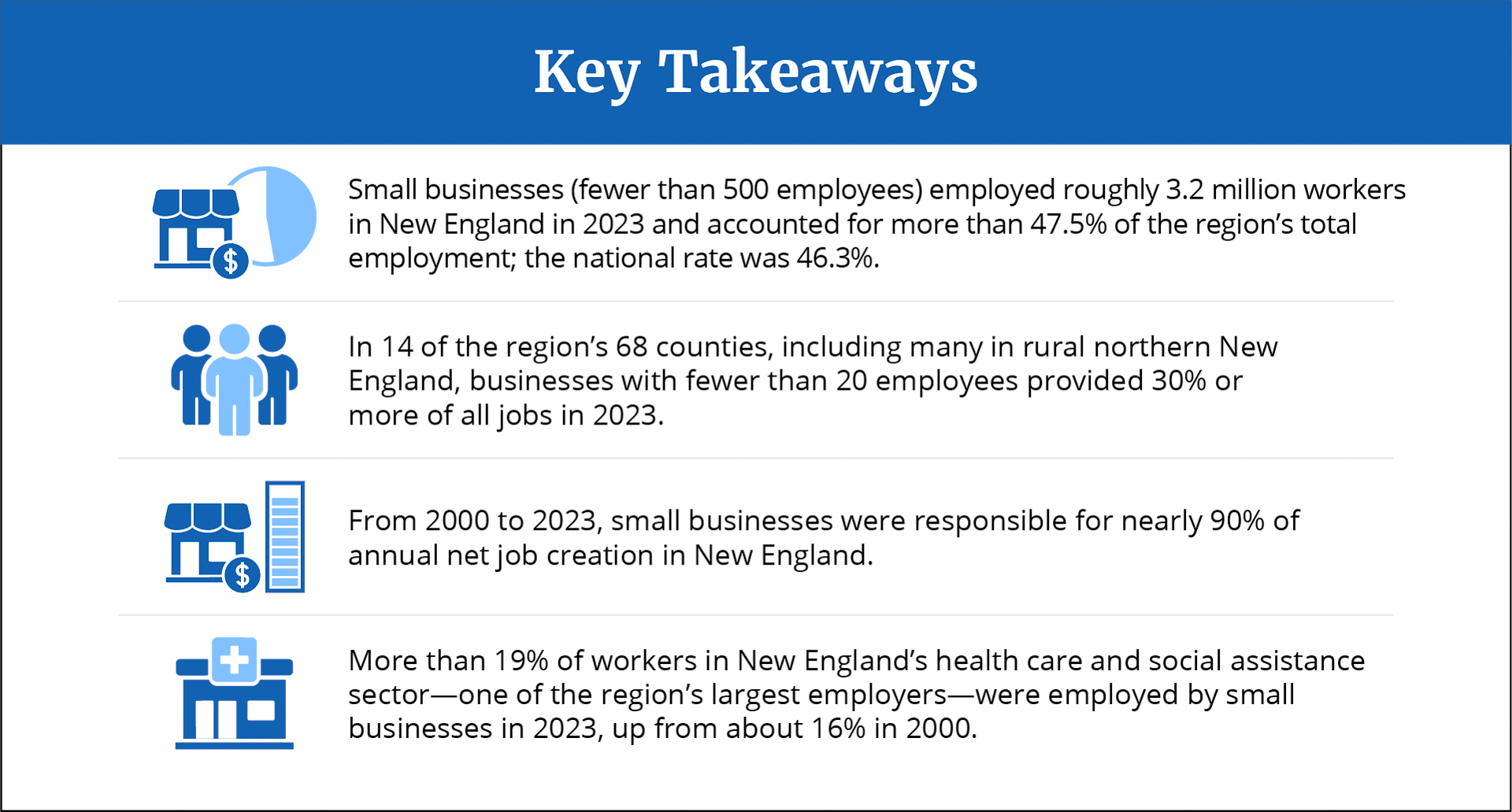
Across the region’s six states, small businesses—defined by the Small Business Association as firms employing fewer than 500 workers—generate economic activity in sectors ranging from professional services to construction to health care. They provided more than 3.2 million jobs in New England in 2023, accounting for more than 47.5 percent of the region’s total employment; nationally, small businesses accounted for 46.3% of total employment. In many of the region’s counties, particularly in rural northern New England, firms with fewer than 20 employees accounted for more than 30 percent of all jobs. And across the region, such businesses employed nearly 1.2 million workers.
Excluding Massachusetts, the New England states collectively and individually rely more on small businesses for employment than the United States does. As of 2023, Vermont had the country’s third highest share of workers employed at small businesses.
Regionally and nationally, the small business share of total employment has trended downward slightly over the last two decades, but these firms remain a vital component of the New England and U.S. economies. In fact, despite the downward trend, small businesses contributed 89.9 percent of net job creation in New England from 2000 to 2023, often from small start-ups growing into larger businesses.
Very Small Businesses Are Very Important for Employment
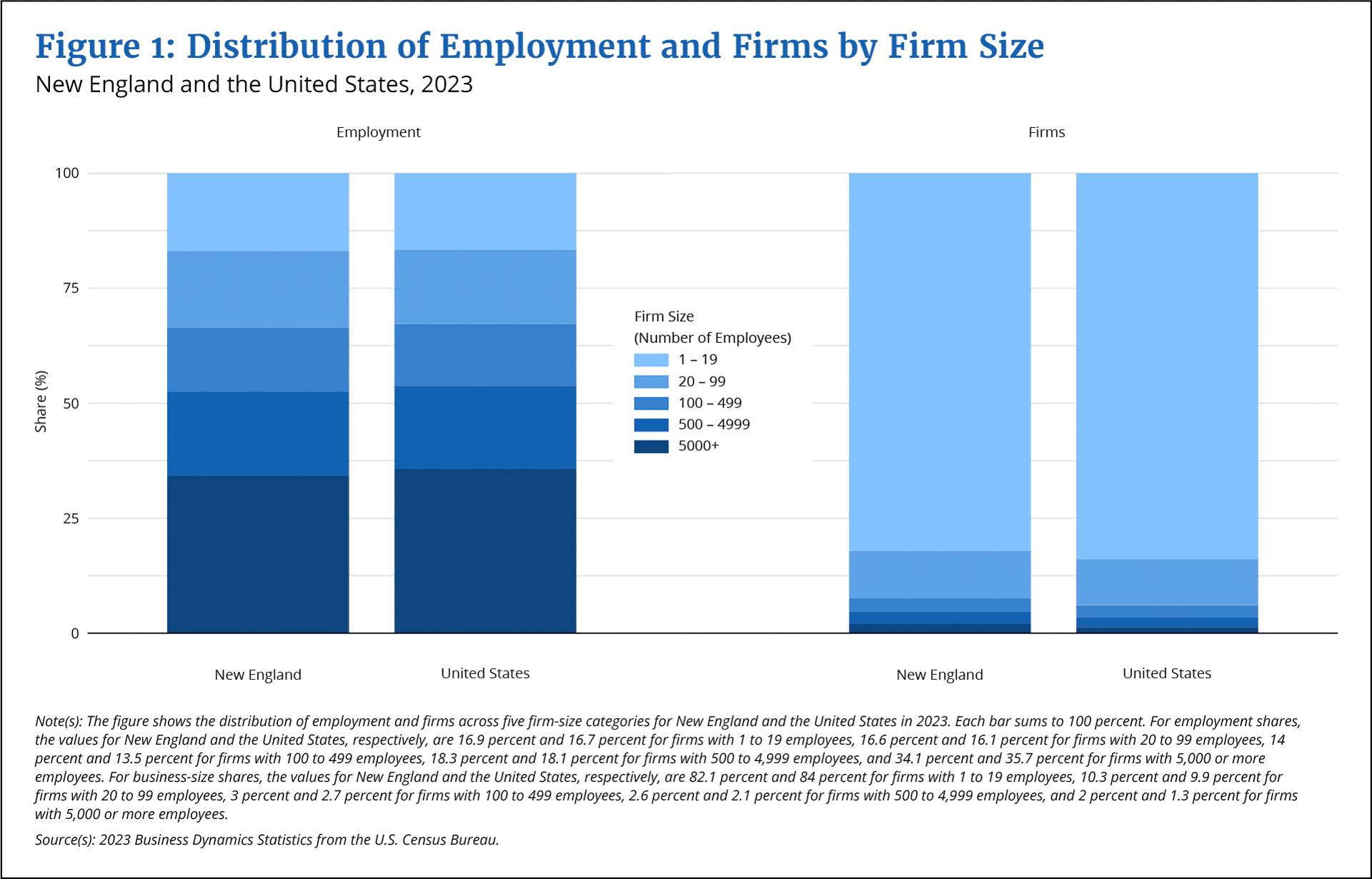
As Figure 1 shows, each of the three small business firm-size groups (1 to 19, 20 to 99, and 100 to 499 workers) employed a larger share of workers regionally than nationally during the 2000–2023 period. The figure also shows the distribution of firm sizes across all employers in New England and in the United States. In the region and in the country, most firms are very small, employing only 1 to 19 workers. In 2023, just over 82 percent of businesses in New England and 84 percent in the United States employed fewer than 20 workers. And the majority of those firms are at the low end of that range, employing very few or just a single worker.
Federal Reserve Bank of Boston
The greater importance of small business employment to the region relative to the country is more pronounced at the state and county levels. Five of the six New England states (excluding Massachusetts) exceeded the national employment share for all three small business firm sizes in 2023 (see Appendix Table 1). The region was led by Vermont, where small businesses accounted for 63 percent of the state’s employment, and firms with fewer than 20 workers accounted for more than 25 percent of the jobs in the state.
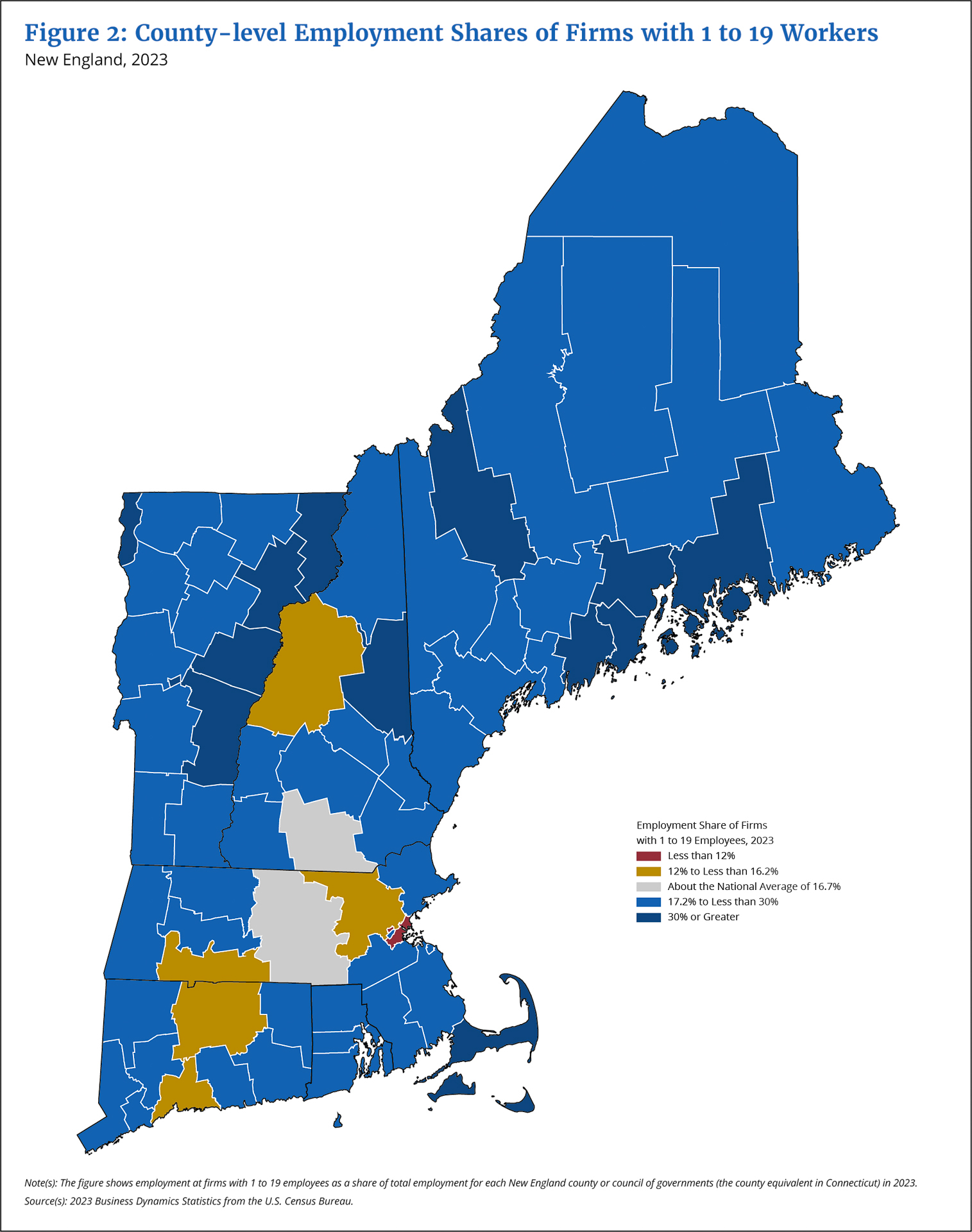
Figure 2 depicts the employment share for businesses with fewer than 20 workers in each New England county. Of the region’s 68 counties, 14 had more than 30 percent of their total employment at very small firms in 2023. The national rate was 16.7 percent. Even in Massachusetts, where the state-level small business employment share was lower than the national rate, three counties (Barnstable, Dukes, and Nantucket) had more than 30 percent of their total employment at very small firms.
Federal Reserve Bank of Boston
In every county in Vermont, Maine, and Rhode Island, the employment share of businesses with fewer than 20 workers was higher than the national share. Many of the counties in which the employment share was lower than the national rate include urban centers, such as Boston, Worcester, Springfield, Hartford, or New Haven, where large businesses are headquartered. Others are home to large institutions that employ many workers. For example, Dartmouth College and Dartmouth–Hitchcock Hospital are in New Hampshire’s Grafton County, the lone county in northern New England where the very small business employment share was lower than the national rate in 2023. The college and the hospital are large employers that likely skew the county’s firm-size employment distribution such that it is more comparable to those of urban areas with larger employers.
Small Businesses Have Been Driving Job Creation
Throughout the 2000–2023 period, small businesses (those with fewer than 20 employees as well as those with 20 to 499 employees) accounted for a larger share of total employment in New England than in the United States. Regionally and nationally, the overall employment share of small businesses trended downward slightly during much of the period, but the employment share of firms with fewer than 20 workers rose slightly during both the Great Recession and the COVID-19 pandemic (see Appendix Figure 1).
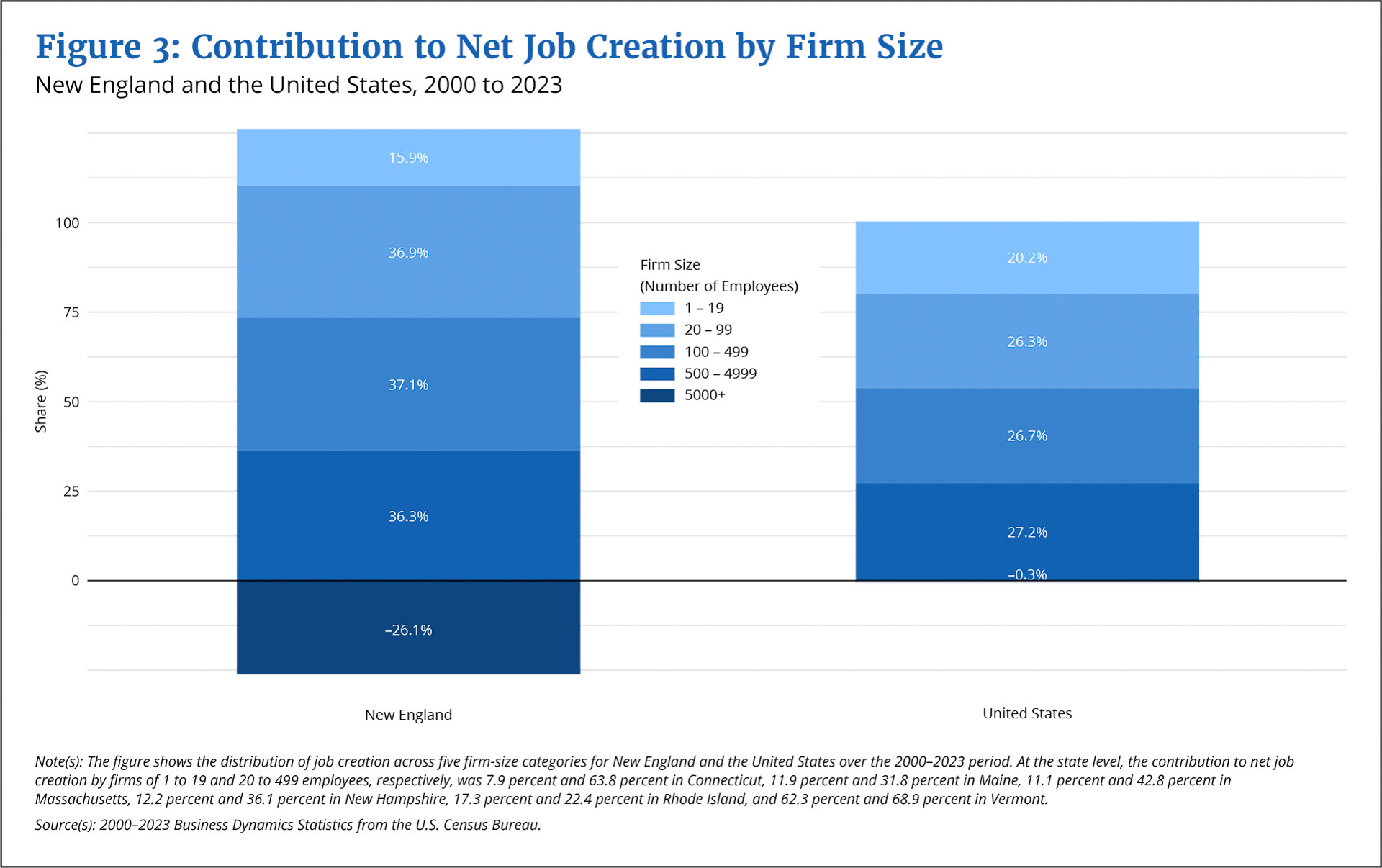
Small businesses drove job creation in both the region and the country from 2000 through 2023, while firms with 5,000 or more employees annually lost jobs, contributing negatively to employment growth. The contribution of small businesses to net job creation was even greater in New England than it was nationally, as Figure 3 shows.2
Federal Reserve Bank of Boston
At the state level in New England, the contribution to net job creation by firms with 1 to 19 employees was highest in Vermont, where it was 62.3 percent over the 2000–2023 period. But Vermont was an outlier; among the region’s other states, the contribution ranged from 7.9 percent in Connecticut to 17.3 percent in Rhode Island. The contribution to net job creation by firms with 20 to 499 workers was also highest in Vermont, at 69.9 percent, followed by Connecticut at 63.8 percent. Among the other New England states, the share of job creation attributed to firms with 20 to 499 workers ranged from 22.4 percent in Rhode Island to 42.8 percent in Massachusetts.
We should note that much of the job creation by small businesses has come from young, rapidly growing firms that are small only because they are new. Studies that control for the age of businesses show that age, not size, is the attribute driving job creation and that these young and growing businesses eventually become larger firms with more stable headcounts (Lawless 2014).
Small Business Employment Share in Health Care Has Grown
Small businesses account for a substantial share of employment in nearly every sector, but in sectors that are particularly important for New England in terms of employment—including construction, professional and business services, health care and social assistance, retail trade, and leisure and hospitality—the regional shares of employment at small businesses are larger than the national shares (see Appendix Table 2).
The health care and social assistance sector, which is among the largest employers in New England, has been one of the driving forces behind employment growth nationally in recent years. In the region relative to the country, small businesses play an outsized role in this sector, with firms of 20 to 499 workers accounting for more than 19 percent of the sector’s employment in 2023, up from about 16 percent in 2020. Nationally, firms with 20 to 499 workers accounted for about 16 percent of the sector’s employment in 2023 and about 12 percent in 2000 (see Appendix Figure 2).
Small Business Owners Have Been Concerned with Insurance and Inflation
The National Federation of Independent Businesses (NFIB), the largest small business advocacy association in the United States, lobbies at the federal and state levels for policies that promote small businesses. It also operates the NFIB Research Foundation, which has collected Small Business Economic Trends (SBET) data since 1973 through monthly and quarterly surveys.
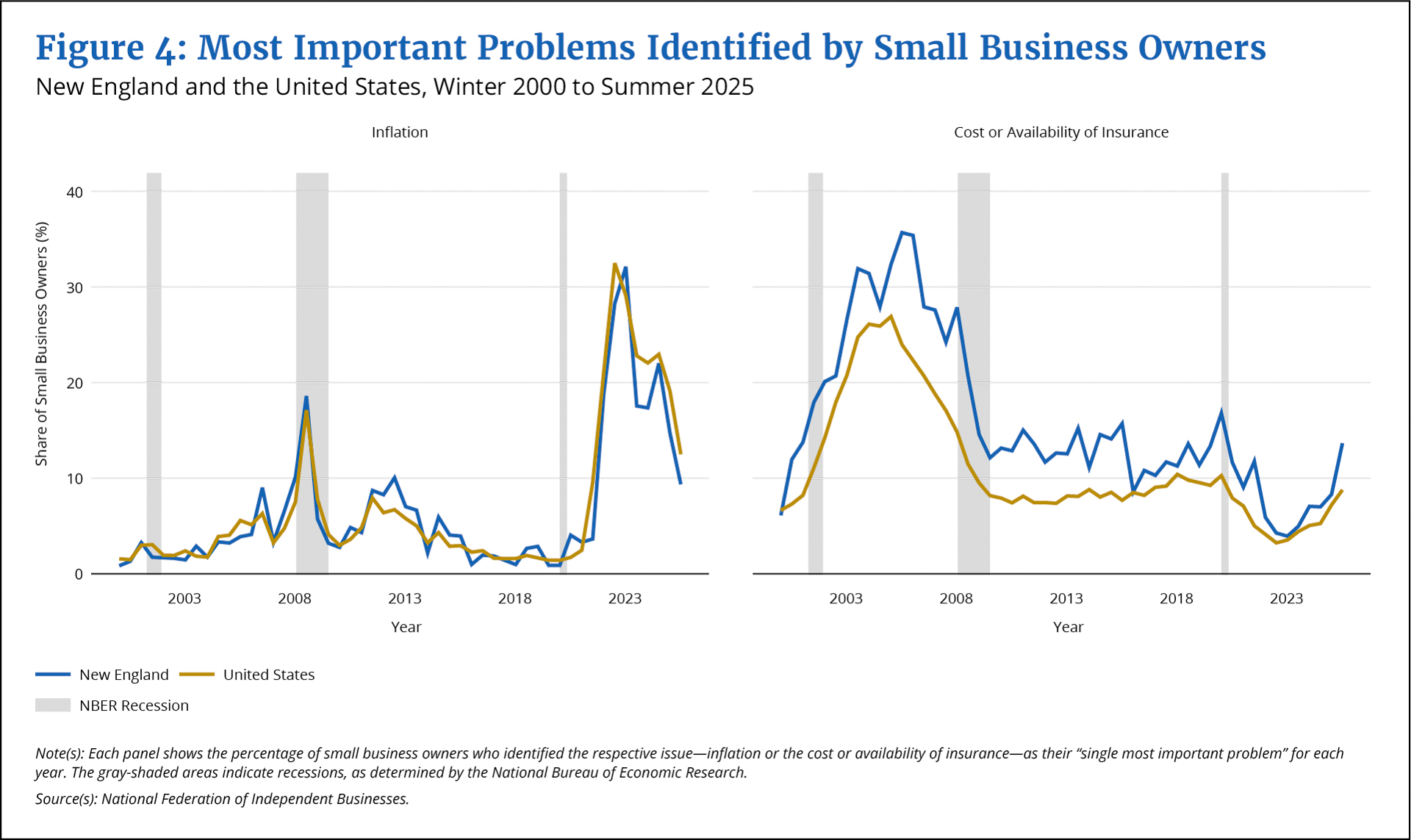
Among other questions, the SBET asks small business owners to identify “the single most important problem” impacting their businesses. According to survey data beginning in 2000, the cost or availability of insurance—employee health insurance as well as property and other general liability insurance—has persistently been top of mind for a sizeable share of small business owners in New England (see the right panel of Figure 4). Relative to small business owners across the country, a larger share of the region’s survey participants consistently have cited this concern as their most pressing one.
Federal Reserve Bank of Boston
As the left panel of Figure 4 shows, in 2022, inflation was the top concern for more than 30 percent of small business owners in both New England and the United States. The most recent available data, from summer 2025, show that the shares of New England and U.S. small business owners most concerned about inflation had sharply declined, falling to about 10 percent and 12 percent, respectively, while the shares of owners most concerned about insurance had spiked modestly in New England and to a lesser degree across the country.
Endnotes
- The data for much of this brief’s analysis come from the U.S. Census Bureau’s 2023 Business Dynamics Statistics, which is the latest available data. More recent data available from other sources are at the establishment level.
- The BDS data measure the net change in employment at the establishment level. A net increase in employment can come from establishments opening or expanding. A net decrease in employment can come from establishments closing or contracting. Gross job gains include the sum of all jobs added at establishments that open or expand. Gross job losses include the sum of all jobs lost at establishments that close or contract. The net change in employment is the difference between gross job gains and gross job losses. For more detailed information, see https://www.census.gov/programs-surveys/bds/documentation/methodology.html.
References
Lawless, Martina. 2014. “Age or Size? Contributions to Job Creation.” Small Business Economics 42:815–830. https://doi.org/10.1007/s11187-013-9513-9

 About the Authors
Nini Liu was a senior research associate with the NEPPC when she contributed to this brief.
Riley Sullivan,
Federal Reserve Bank of Boston
Riley Sullivan is the lead policy analyst with the New England Public Policy Center in the Federal Reserve Bank of Boston Research Department.
Email: riley.sullivan@bos.frb.org
Jeffrey P. Thompson,
Federal Reserve Bank of Boston
Jeffrey P. Thompson is a vice president and economist in the Federal Reserve Bank of Boston Research Department, where he is the director of the New England Public Policy Center.
Email: jeffrey.thompson@bos.frb.org
Acknowledgments
The two primary data sources for this brief are the US Census Bureau’s 2023 Business Dynamics Statistics (BDS) and data provided by the National Federation of Independent Businesses (NFIB).
The BDS tracks changes in the population of businesses over time, providing annual measures of establishment openings and closings, firm startups and shutdowns, and job creation and destruction. These measures are available for the entire economy and by industrial sector, three-digit and four-digit North American Industry Classification System codes, state, metropolitan statistical area, and county. They are also available by firm and establishment size and age. The BDS is created from the Longitudinal Business Database (LBD), a confidential database available to qualified researchers through secure Federal Statistical Research Data Centers. For more information, see https://www.census.gov/programs-surveys/bds/about.html.
The NFIB Research Center promotes greater understanding of small business and the conditions that impact it. The center produces and disseminates various surveys and studies on small business, focusing on areas related to public policy’s effects. The authors of this brief thank Peter Hansen, director of research policy and analysis at the NFIB, for creating and providing a New England sample that enables a comparison between the concerns of small business owners in New England and those of small business owners across the country. For more information, see https://www.nfib.com/small-business-trends-research/.
Resources
Site Topics
Keywords
- New England ,
- NEPPC Regional Brief ,
- small businesses ,
- employment ,
- health care