From teller and janitor to chair, Eastern Bank’s Rivers prioritizes community banking mindset 
Rivers represents New England on the Federal Reserve’s Federal Advisory Council


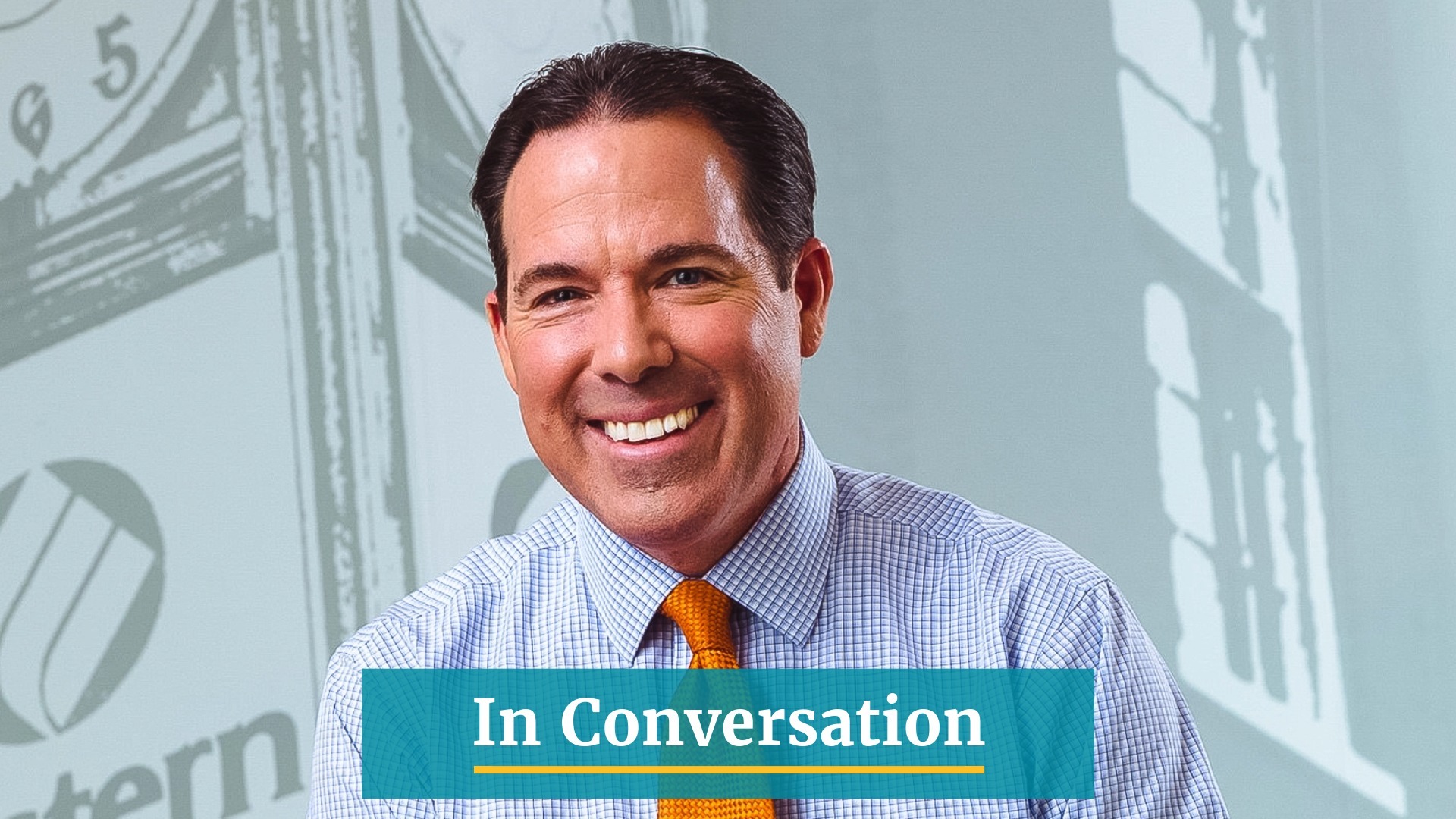
Robert Rivers is executive chair and chair of the Board of Directors of Boston-based Eastern Bankshares, Inc. and Eastern Bank, a $30 billion financial institution with 125 branches. He is also the Boston Fed’s representative to the Federal Reserve System’s Advisory Council. We spoke with Rivers about his career and his community focus.
You began as a bank teller and janitor, and today you lead Eastern Bankshares and Eastern Bank. Did you imagine this would be your path?
Yes and no. When I was a senior at Stonehill College, we were given an assignment to write a business plan for our lives, and we were instructed to aim high. The professor said, “Aim higher than you think you would go, because if you fall short, you'll end up further ahead than you otherwise would have thought.”
So, I wrote, “I'm going to be the president of the largest bank based in Boston by the time I'm 40.”
I didn't say that with any amount of seriousness. I wasn't even sure if I was going to stay in banking. But over time, it stayed with me, and as my career progressed, I attempted to approximate that goal in some way.
And at 42, I became president of Eastern Bank, which was and still is the largest community bank headquartered in Boston.
Did you have any mentors that helped you along the way?
I’ve been fortunate to have several important mentors. One was the college professor who gave me that assignment. He really shaped my thinking early on.
My father was also a major influence. He encouraged me to apply for my first job as a bank teller, which I did during summers and part-time when I was in school, in addition to being a bank janitor throughout the year.
I learned from my father’s professional experiences as well, including being laid off twice during recessions in the 1970s. As the oldest of three children, I stood in the unemployment line with him (I was 9 and 13 at the time), and I learned a few things. First, whenever he was laid off, it was always a surprise, he never saw it coming. Secondly, he was a lifetime auditor, so when he looked for a new job, he had only one set of skills to offer.
As a result, although I had no idea then what I would ultimately do with my life, I knew I wanted to be in top management, so I could hopefully see a layoff coming. I also wanted to have a lot of different skills, so if I was laid off, I had options.
Eastern Bank is known for its community focus. How do you see community banks evolving?
Community banks need to stay deeply connected to the people and issues in their region – that’s the core of our model. We’re a $30 billion institution now, but we see community banking as a mindset, not a function of our size.
The more we invest in our communities, the stronger they become, and that directly strengthens our business. Our footprint is in Massachusetts, New Hampshire, and Rhode Island, so our success is tied to our region’s success. It’s critically important that we do everything we can to protect and grow the communities we serve, and who, in turn, support us.

Federal Reserve Bank of Boston
What are the biggest challenges you see ahead for Eastern Bank and the region?
Without question, the lack of housing affordability is the top challenge for our region, and, by extension, all its employers – especially community banks. It limits our ability to attract and retain talent, as younger people increasingly leave for states with more affordable housing options and, often, better weather. We’re a business that relies upon the growth and vibrancy of the communities we’re in, and the loss of the labor and the discretionary spending of this younger generation threatens the viability of our small business customers. It also puts more pressure on local nonprofits, who will increasingly look to us for support.
Eastern Bank became a public company in 2020. What were some of the biggest challenges and opportunities that came with that transition?
It was a very difficult decision to convert from a mutual bank after over 200 years, but we saw this as an opportunity to better position Eastern to be around for another two centuries. At the time, we were the oldest and largest mutual bank in the country, and we were proud of that. But we also recognized that the industry was changing rapidly, and we wouldn’t be able to competitively serve our customers and keep growing the way we had in the past.
We were also thinking about our employees and our communities. If we couldn’t keep growing, we worried our staff would have fewer opportunities, and we wouldn’t be able to support our communities like we had –through philanthropy, volunteer work, and advocacy.
Becoming a public company gave us the resources to invest, scale, and grow much faster. We’ve grown rapidly over the past five years — including tripling in size through three major mergers. That’s certainly brought challenges, especially around operational and cultural integration. But overall, it’s absolutely been worth it.

Federal Reserve Bank of Boston
You act as the Boston Fed’s representative to the Federal Reserve System Advisory Council in Washington. Can you describe your role and what you’ve learned?
The Federal Advisory Council’s job is to bring real-time, forward-looking, “on the ground” perspectives on the economy to the Federal Reserve’s Board of Governors. These are things you can’t always see in the data, like customer sentiment or emerging trends. It’s striking how much regional variation there is, and the differences across the 12 Federal Reserve Bank districts are particularly important for us to highlight in our report.
The council is comprised of bank CEOs from each of the 12 districts. My role as a representative is to reach out to other banks in my district to collect information and perspectives about the economy. Despite having more than $30 billion in assets, Eastern is among the smaller banks that’s been on the Council. Needless to say, between my colleagues on the council, my meetings with the Board of Governors, and the variety of speakers who visit us, I’ve learned a great deal — and I know I still have much to learn!
Media Inquiries?
Contact our media relations team. We connect journalists with Boston Fed economists, researchers, and leadership and a variety of other resources.

 About the Authors
Allison Ross is a member of the communications team at the Federal Reserve Bank of Boston.
Email: Allison.Ross@bos.frb.org
Site Topics
Keywords
- New England ,
- New England region ,
- New Hampshire ,
- New England Economic Outlook ,
- Massachusetts ,
- Rhode Island