How Concerns about Artificial Intelligence and Affordability Have Affected Workers’ Expectations about Saving 


Federal Reserve Bank of Boston

The views expressed herein are solely those of the authors and should not be reported as representing the views of the Federal Reserve Bank of Boston, the principals of the Board of Governors, or the Federal Reserve System.
In Bracha, Hagler, and Tang (2026), a recent Federal Reserve Bank of Boston brief, the authors present survey results showing that workers’ concerns about AI-related job loss increased from 2024 to 2025. About 10 percent of respondents to the December 2025 wave of the survey expressed fear about losing their own job due to AI, and 60 percent indicated that they expected layoffs or a decline in employment in their industry.
This brief uses the same survey as Bracha, Hagler, and Tang (2026) to build on that study, addressing how concerns about AI-related job loss may influence workers’ expected saving behavior as adoption of this technology progresses through the economy.1 We focus on how such concerns have affected workers’ expectations about saving, how these expectations changed from 2024 to 2025, how they varied across demographic groups, and how, in 2025, workers’ self-reported changes in purchasing power further impacted their saving outlook.
Sign up for Research Department Updates.
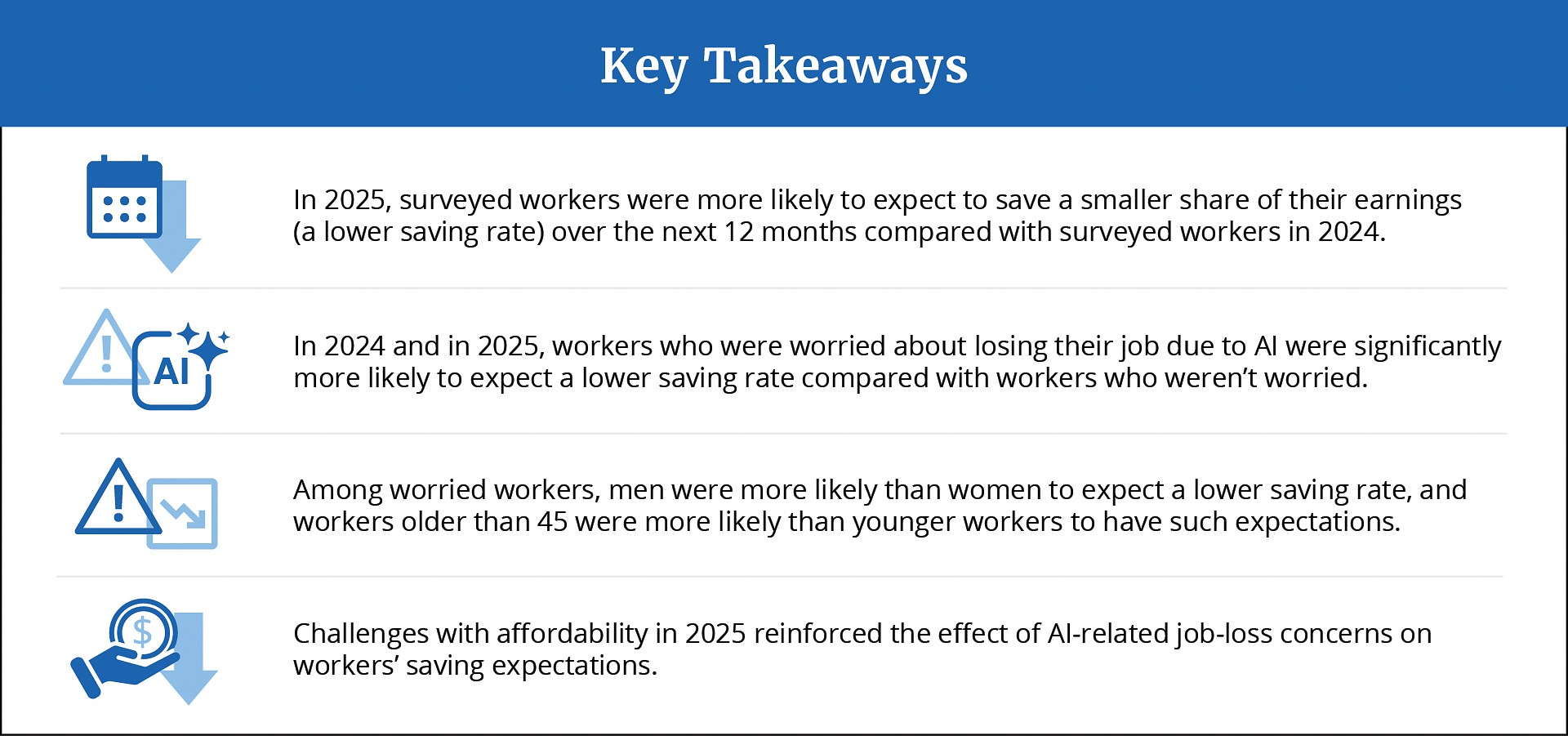
We ask workers about their expected saving rate over the next 12 months—the share of income that they planned to save rather than invest or spend—and find that, compared with workers surveyed in 2024, a larger share of workers surveyed in 2025 expected their saving rate to decline. We also find that, in 2024 and in 2025, workers who were worried about losing their job due to AI were more likely to expect a lower saving rate compared with workers who weren’t worried.
Among worried workers, men were more likely than women to expect a decline in their saving rate, and workers older than 45 were more likely than younger workers to have such expectations. Experience using AI professionally seems to have tempered expectations of a lower saving rate more for older workers than for younger workers. Moreover, challenges with affordability in 2025 reinforced the effect of AI-related job concerns on workers’ saving expectations.
Job-loss Concerns May Affect Saving Behavior
When workers are worried that they will lose their job or experience some other adverse income shock, they may adjust (or plan to adjust) their spending and saving in anticipation of having fewer resources. A large volume of research focuses on households’ so-called precautionary saving motive, which is based on the idea of saving for a rainy day; that is, individuals save more out of their income while possible to help sustain their spending in the future if or when they experience a loss of income. The stronger their belief that their income will be reduced, the more motivation they may have to save in anticipation of that loss.
In this context, we might anticipate that survey respondents who were worried about losing their job due to AI would report that they expected to save more as a hedge. Of course, we would have to assume that the respondents had sufficient resources to adjust their saving and, more importantly, that they did not expect to lose their job soon. Instead, as noted earlier, we find a negative relationship between AI-related job-loss concerns and saving expectations, in which worried workers expected to save less. This result suggests that the relationship may depend on worker characteristics and their overall economic well-being.
Share of Workers Worried about Job Loss Grew Rapidly
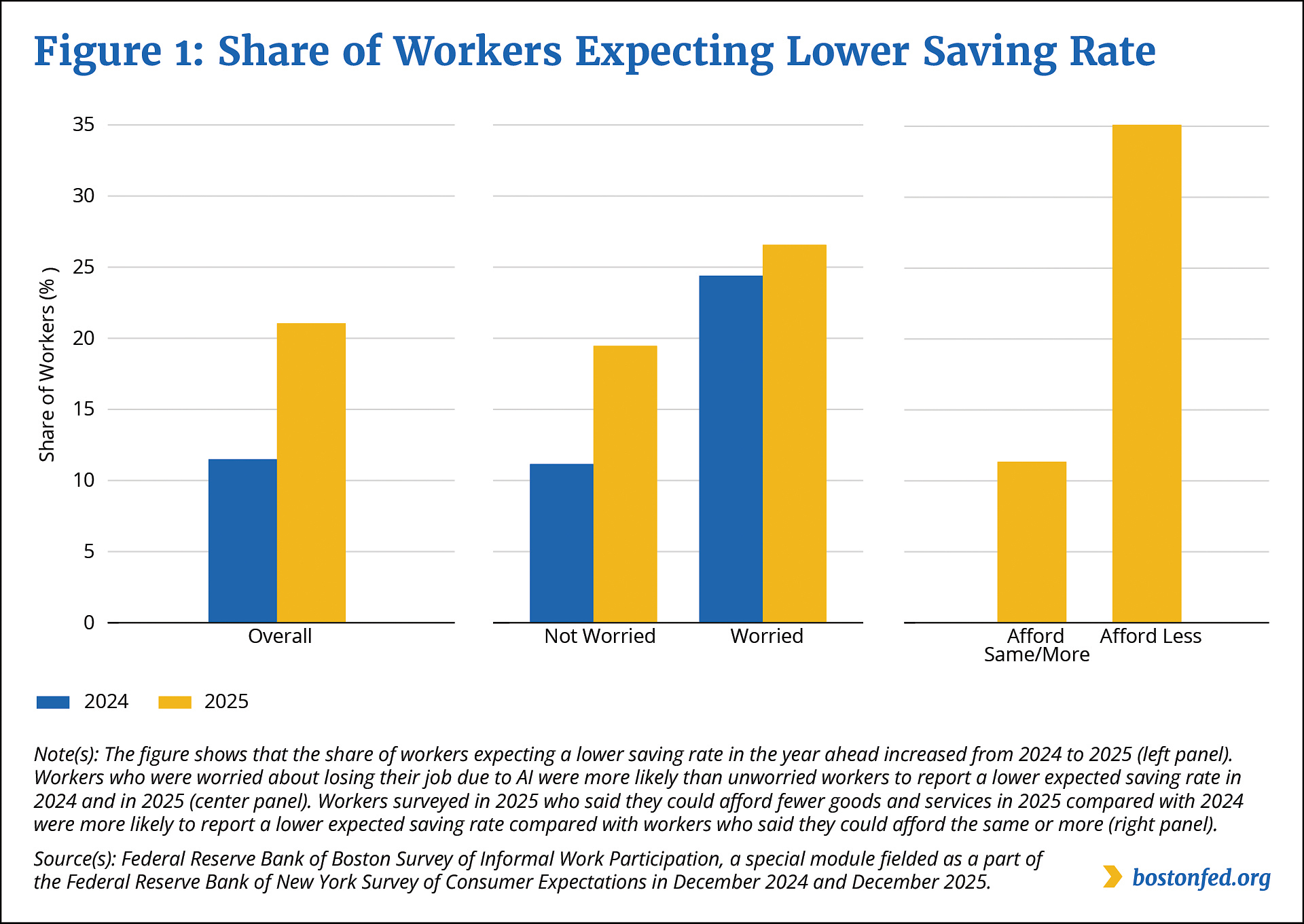
In 2024 and 2025, survey participants were asked if they agreed with the following statement: “I expect to save a lower share of my earnings next year compared to this year.” The left panel of Figure 1 compares the 2025 share of respondents who replied affirmatively with the 2024 share. It shows that this fraction nearly doubled from 11 percent in 2024 to 21 percent in 2025.2
Federal Reserve Bank of Boston
The figure’s middle panel shows the shares of respondents expecting a lower saving rate based on whether they expressed worry about losing their job due to AI. While the share expecting to save less was larger in 2025 than in 2024, concerned workers were more likely to expect a lower saving rate over the next 12 months in 2024 and in 2025. As Appendix Table A shows, workers who were worried about AI-related job loss tended to be more educated. They were also younger, on average, and a substantial number had used AI at their workplace, all of which is broadly consistent with anecdotes suggesting that AI has been especially disruptive to more educated, younger workers in entry-level positions.
Higher prices and uncertain economic conditions at the end of 2025 may have contributed to the increase in the share of workers with expectations of a lower saving rate. We divided workers surveyed in 2025 based on whether they said they could afford the same or fewer goods and services in 2025 compared with 2024. As the right panel of Figure 1 shows, among those who said they had less purchasing power in 2025, 35 percent expected a lower saving rate, whereas only 11 percent of those who said they could afford the same goods and services expected a lower saving rate.3
Who Is Actually Saving Less?
While the results presented in Figure 1 provide initial evidence that workers who were worried about losing their job due to AI expected to save less, those results are unconditional, meaning they don’t take any other potentially confounding factors into account. Numerous demographic, financial, geographic, and employment-related factors also could have affected respondents’ views about AI and their expectations about saving, independently or collectively. To help isolate the impact of AI-related job-loss concerns on saving expectations, we use a simple linear probability regression model in which we consider as much information as possible about the survey respondents.4
Federal Reserve Bank of Boston
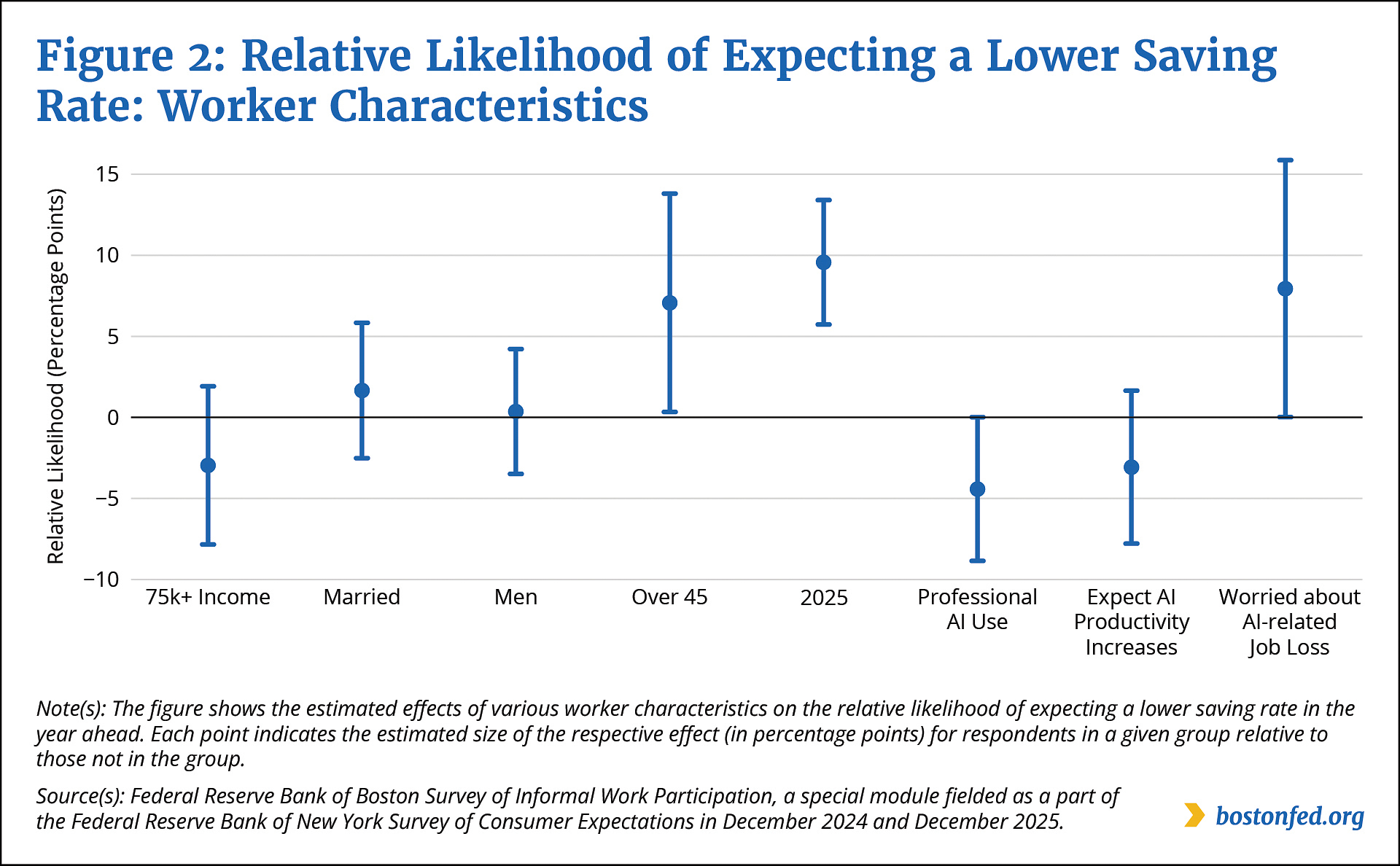
Figure 2 plots the effect of selected factors on saving expectations from our baseline conditional analysis. The horizontal axis label identifies the group for which the effect is measured relative to workers not in that group, all else equal—meaning we measure the effect while holding all other relevant factors constant. For example, “Married” captures the effect of a worker being married compared with not being married. The dot associated with each group (here and in later figures) shows the estimated magnitude of the effect (in percentage points), and the whiskers indicate the degree of uncertainty around each estimate; shorter whiskers indicate a more precise estimate.5
When we account for the effects of other factors, we find that respondents who were worried about losing their job due to AI were roughly 8 percentage points more likely to expect a lower saving rate in the year ahead compared with respondents who were not concerned. On the surface, this suggests that worries about AI-related job loss did not lead to increased precautionary saving. However, these individuals may already have been experiencing or expecting to experience some financial distress that limited their ability or desire to save.
As the figure shows, the estimates also confirm our earlier finding that the share of respondents expecting a lower saving rate in the year ahead increased from 2024 to 2025. In addition, our estimates indicate that differences in saving expectations associated with gender and marital status were limited, but higher-income respondents, those who had used AI professionally, and those who expected increased productivity due to AI were less likely to expect a lower saving rate in the coming year.
Higher-income workers may have been less financially constrained in general and therefore less likely to expect a lower saving rate. The relationship between perceptions about AI’s ability to increase productivity and saving expectations may align with the Bracha, Hagler, and Tang (2026) finding that workers experiencing the greatest productivity gains due to AI were the most willing to ask for a raise. This is broadly consistent with increased productivity fueling wage demands. Expectations of faster wage growth could lead some workers to anticipate greater saving capacity.
The Impact of AI Concerns on Saving Expectations by Worker Characteristics
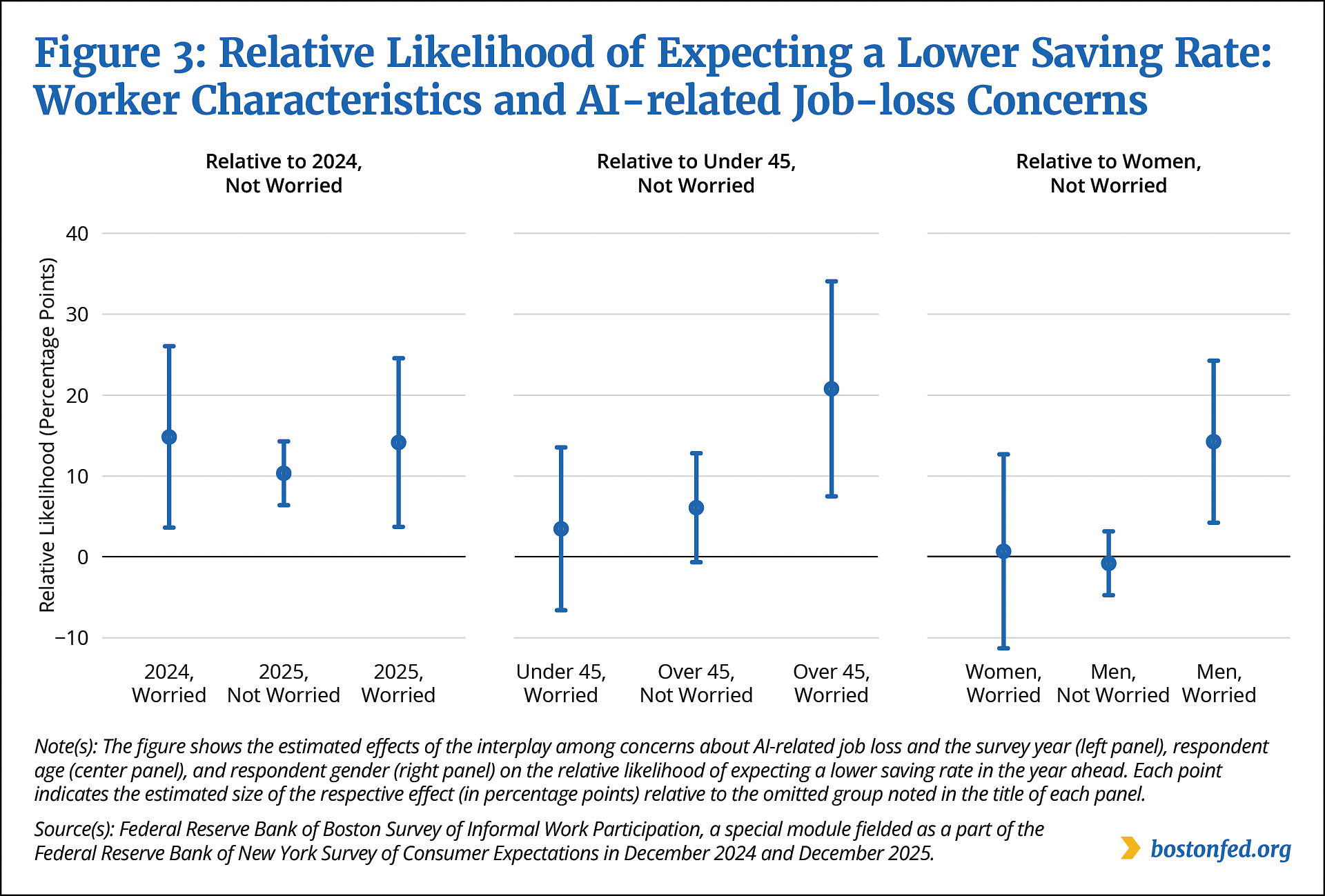
Figure 3 shows the results when we consider the extent to which certain worker characteristics—age, gender, and year in which the worker responded to the survey—interact with concerns about AI-related job loss to reinforce or reduce the effect of those concerns on saving expectations, all else equal.
Federal Reserve Bank of Boston
While concerns about AI-related job loss play an important role in workers’ saving expectations, the survey year also matters. As the figure’s left panel shows, workers who were not concerned about job loss in 2025 were 10 percentage points more likely than unconcerned workers in 2024 to expect a lower saving rate in the coming year. Moreover, workers who were worried about job loss in 2024 and in 2025 both were roughly 15 percentage points more likely to expect a lower saving rate than unconcerned workers in 2024. This finding suggests that while the year of the survey may have had some effect on saving expectations, job-loss concerns were more important overall.
In addition, the survey results indicate that younger workers in general were more likely to express worries about job loss. As the middle panel of Figure 3 shows, workers older than 45 were 21 percentage points more likely to expect a lower saving rate in the coming year compared with younger unconcerned workers. The differences in saving expectations between younger concerned workers and younger unconcerned workers and between older unconcerned workers and younger unconcerned workers are less pronounced. It is worth noting though that younger workers may have less accumulated wealth (savings) and generally expect to have a lower saving rate in the first place given their stage in life.
As for the interaction between gender and AI-related job-loss concerns, the largest effects (relative to unconcerned women) were for worried men, while worried women and unconcerned men were not more likely to expect a lower saving rate, as shown in the right panel of Figure 3. Overall, these results suggest that, among workers worried about AI-related job loss, older workers and men were especially likely to expect to save less in the year ahead.
We also look at whether on-the-job use of AI (professional use) interacts with AI-related job-loss worries and demographics in affecting saving expectations. While professional use of AI does not offset the importance of AI-related job-loss concerns and the survey year (2025) in determining respondents’ saving expectations, some notable patterns among professional use, age, and AI-related job-loss concerns emerge. In particular, worried workers older than 45 who had not used AI professionally expected a lower saving rate in the coming year, but so did younger respondents who were worried and had used AI professionally. This adds nuance to the results from Figure 3, suggesting that some younger respondents (those with AI exposure) expected to save less due to AI-related job-loss concerns. Moreover, experience with AI in the workplace seems to have substantially tempered the effect of AI-related worries on older workers’ saving expectations.
While these results are broadly consistent with anecdotal evidence that AI is limiting employment in entry-level positions that often are occupied by younger, more educated workers, the findings come with several caveats. For example, older workers who have used AI professionally may be better off financially (including having more savings). They could also be less concerned about finding a new position, despite worrying about losing their current job, if they have gained valuable experience and developed marketable, non-AI-related skills over time at their job.
Additionally, our results for professional use may partly reflect our finding that respondents in 2025 generally expected to save less than respondents in 2024. Indeed, when we further consider how the survey year interacts with job-loss concerns, professional use of AI, and age, we find that being surveyed in 2025 has a larger impact than professional use on older workers’ saving expectations. Still, having used AI professionally mattered for concerned younger workers’ saving expectations in 2025.6
The Effect of Affordability on Saving Expectations
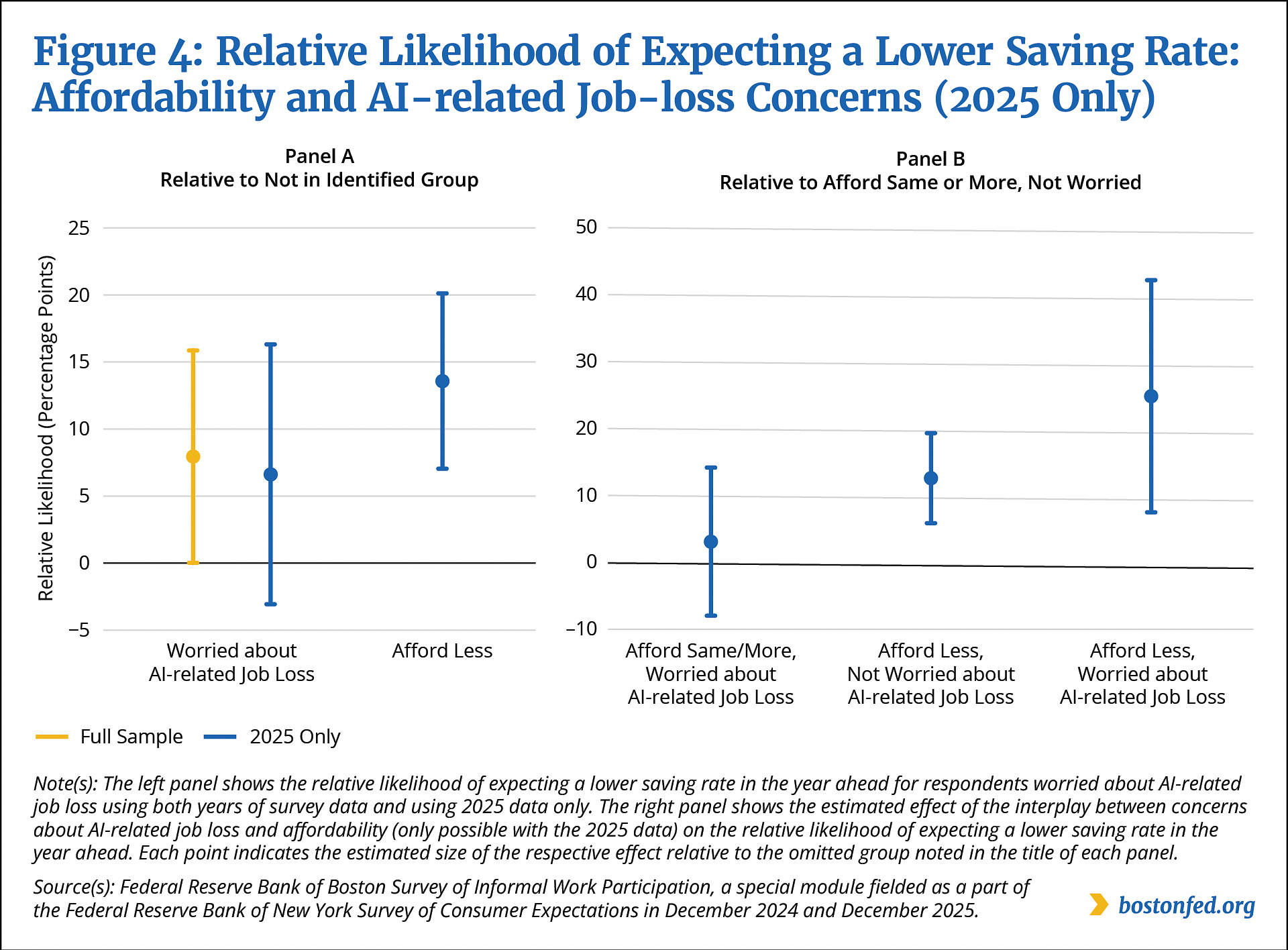
In the 2025 wave, survey participants were also asked whether they could afford the same quality and quantity of goods and services that they had purchased in 2024. When we include concerns about affordability in our analysis (of only the 2025 responses), the effects of the other factors on saving expectations, including concerns about AI-related job loss, become slightly smaller and less precisely estimated, indicating that affordability concerns account for some of the variation in workers’ saving expectations in 2025. For example, as the blue dot in the left panel of Figure 4 shows, respondents who said they could afford less were twice as likely to expect a lower saving rate in the coming year compared with those who were concerned about AI-related job loss, all else equal.
Federal Reserve Bank of Boston
The middle dot in the right panel of Figure 4 shows that respondents who were not worried about AI-related job loss and reported that they could afford less in 2025 were 13 percentage points more likely to expect to save less than unconcerned respondents who did not report affordability issues. The estimated size of this effect is similar to the direct effect of affordability concerns on saving expectations, represented by the right dot in the left panel.7 However, the effect on saving expectations for respondents who reported affordability challenges and AI-related job-loss concerns (right panel, right dot) was nearly double that of respondents who could afford less and were not worried about AI-related job loss (right panel, middle dot). This suggests that worries about affordability and AI-related job loss reinforced each other in terms of anticipated saving.8 Workers with both concerns may be the most likely to expect their financial situation to deteriorate further.9 Together, these results suggest that in 2025, at least, concerns about affordability played a role in whether workers expected to save less going forward.
Endnotes
- The survey was conducted within a special module of the Federal Reserve Bank of New York Survey of Consumer Expectations (SCE), a nationally representative, monthly, internet-based survey of a rotating panel of approximately 1,300 US household heads. Like Bracha, Hagler, and Tang (2026), we use the results from two waves of the survey for our analysis. The first was conducted in December 2024 and the second in December 2025.
- Like Bracha, Hagler, and Tang (2026), we focus our analysis on respondents who were employed at the time of the survey.
- In 2025, roughly 41 percent of all workers answered “No” to the following survey question: “Would you have been able to afford the same goods and services in 2025 that you purchased in 2024?”
- Our analysis accounts for a host of respondent characteristics, including whether a respondent’s saving rate in 2024 was less than their saving rate in 2023. Accounting for respondents’ recent saving behavior helps address concerns that our estimated effects may reflect unobserved or other inherent respondent characteristics—such as a string of bad circumstances or persistently pessimistic views of one’s financial situation—that impact their expected saving rate. Our estimates also control for the survey year to capture changes in expectations and behavior over time. The appendix contains additional details about our regression specification and variable definitions.
- We plot the 90 percent confidence interval around each estimate.
- These results should be viewed with some caution because for several of the groups in question, the number of respondents was small.
- Note that when we consider interactions between AI-related job-loss worries and age or between AI-related job-loss worries and gender, we find results similar to what we found earlier after controlling for affordability in 2025. The same is true for the interplay among job-loss concerns, gender, and age, whereby worried men and women who are older and worried expected to save less. Notably, women who are younger and worried were less likely to expect a lower saving rate in the coming year—an effect that was slightly evident in our full-sample analysis but more pronounced and precisely estimated for the 2025 sample.
- Taking the analysis one step further and looking at the interplay among affordability, AI-related job-loss concerns, and age, we find that this effect is particularly evident for men and older respondents (not shown).
- These effects are all relative to being able to afford the same or more than in 2024 and not being worried about AI-related job loss.
References
Bracha, Anat, Rees Hagler, and Jenny Tang. 2026. “Workers’ Perspectives on Artificial Intelligence: Productivity Gains and Job-loss Fears.” Federal Reserve Bank of Boston Current Policy Perspectives 26-8.
Caballero, Ricardo J. 1990. “Consumption Puzzles and Precautionary Savings.” Journal of Monetary Economics 25(1): 113–136.
Carroll, Christopher D. 1997. “Buffer-Stock Saving and the Life Cycle/Permanent Income Hypothesis.” The Quarterly Journal of Economics 112(1): 1–55.
Gourinchas, Pierre-Olivier, and Jonathan A. Parker. 2002. “Consumption over the Life Cycle.” Econometrica 70(1): 47–89.
Leland, Hayne E. 1968. “Saving and Uncertainty: The Precautionary Demand for Saving.” The Quarterly Journal of Economics 82(3): 465–473.

 About the Authors
Cecelia Chapleau,
Federal Reserve Bank of Boston
Cecelia Chapleau is a senior research associate in the Federal Reserve Bank of Boston Research Department.
Daniel H. Cooper,
Federal Reserve Bank of Boston
Daniel H. Cooper is a vice president and economist in the research department at the Federal Reserve Bank of Boston.
Email: Daniel.Cooper@bos.frb.org
Rees Hagler,
Federal Reserve Bank of Boston
Rees Hagler is a senior research associate in the Federal Reserve Bank of Boston Research Department.
Resources
Site Topics
Keywords
- Artificial Intelligence ,
- AI ,
- Job displacement ,
- job security
JEL Codes
- C83 ,
- D84 ,
- E21 ,
- J24 ,
- O33
Citation
Chapleau, Cecelia, Daniel H. Cooper, and Rees Hagler. 2026. “How Concerns about Artificial Intelligence and Affordability Have Affected Workers’ Expectations about Saving.” Federal Reserve Bank of Boston Current Policy Perspectives 26-9.