Workers’ Perspectives on Artificial Intelligence: Productivity Gains and Job-loss Fears 


Federal Reserve Bank of Boston

The views expressed herein are solely those of the authors and should not be reported as representing the views of the Federal Reserve Bank of Boston, the principals of the Board of Governors, or the Federal Reserve System.
The consensus among economists is that productivity gains and investments related to artificial intelligence (AI) are important factors contributing to the current resilience of the US economy; however, the implications for the labor market are not yet clear. To better understand how the AI revolution has been affecting US workers, we surveyed household heads about their perceptions and expectations regarding AI in December 20241 and a year later, in December 2025. Each of the two survey waves was conducted within a special module of the Federal Reserve Bank of New York Survey of Consumer Expectations (SCE), a nationally representative monthly internet-based survey of a rotating panel of approximately 1,300 US household heads.
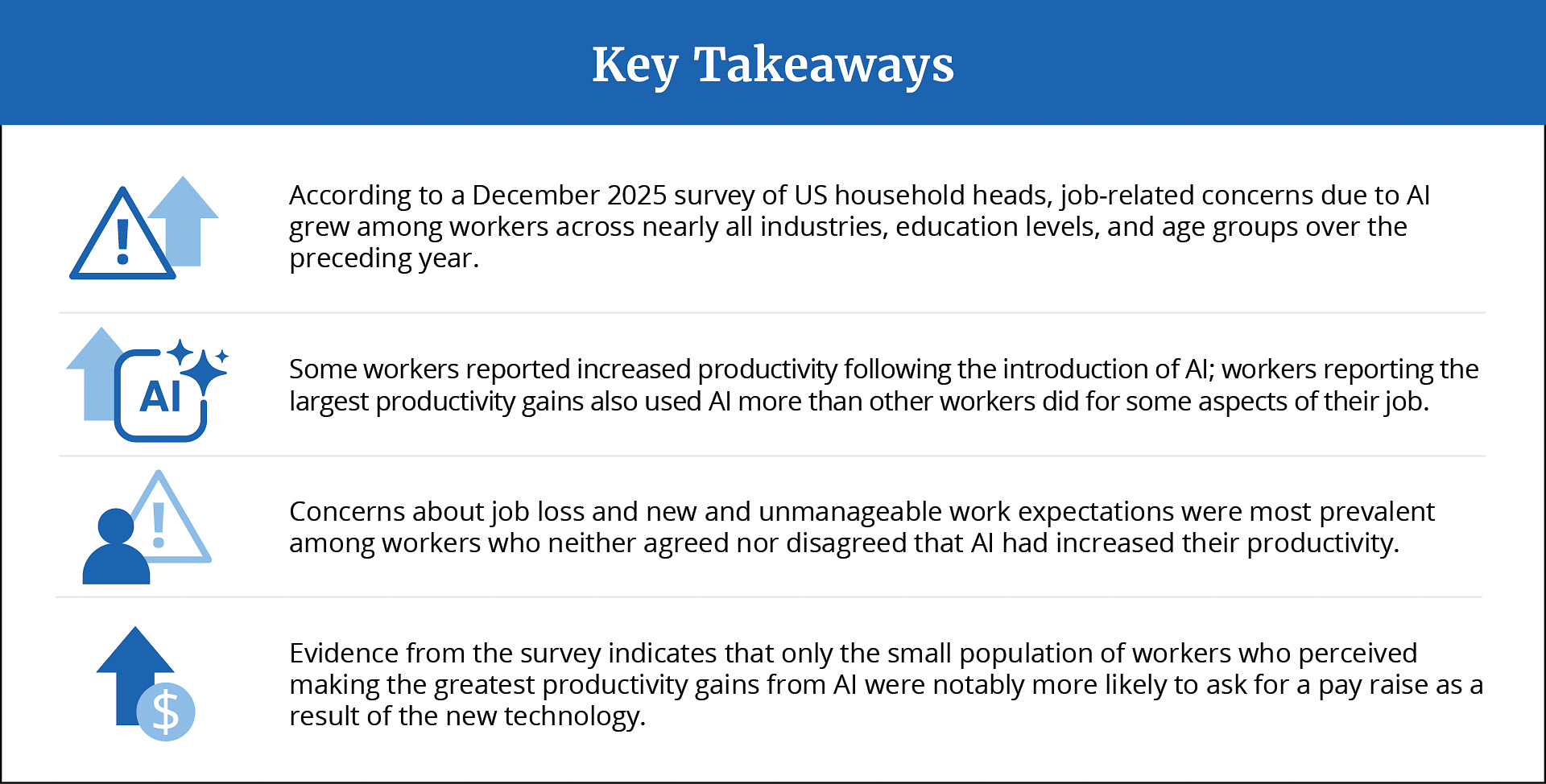
The survey results indicate that concerns about negative job-related outcomes due to AI, job-loss fears in particular, grew from 2024 to 2025. This increase is evident across nearly all industries, educational levels, and age groups. Workers who engaged in some task substitution—that is, those who relied on AI for some of their tasks—but perceived making at most only minimal productivity gains from AI were the most concerned, whereas workers who perceived experiencing the largest productivity gains remained relatively more optimistic about their job security.
Sign up for Research Department Updates.
We find evidence in the survey results indicating that this group of optimistic workers may generate increased wage pressures, as 14 percent of them reported being more likely to ask for a raise since the introduction of AI in their industries. However, this group represents only 6 percent of all workers in our sample.
Our results align with recent academic work (Humlum and Vestergaard 2026) that finds jobs are changing as AI enables workers to spend less time on some tasks and reallocate it to new assignments. Overall, the survey results point toward workers believing that AI will have a long-term effect of restructuring many jobs rather than eliminating human labor on a large scale.
Share of Workers Concerned about AI-related Job Loss Grew
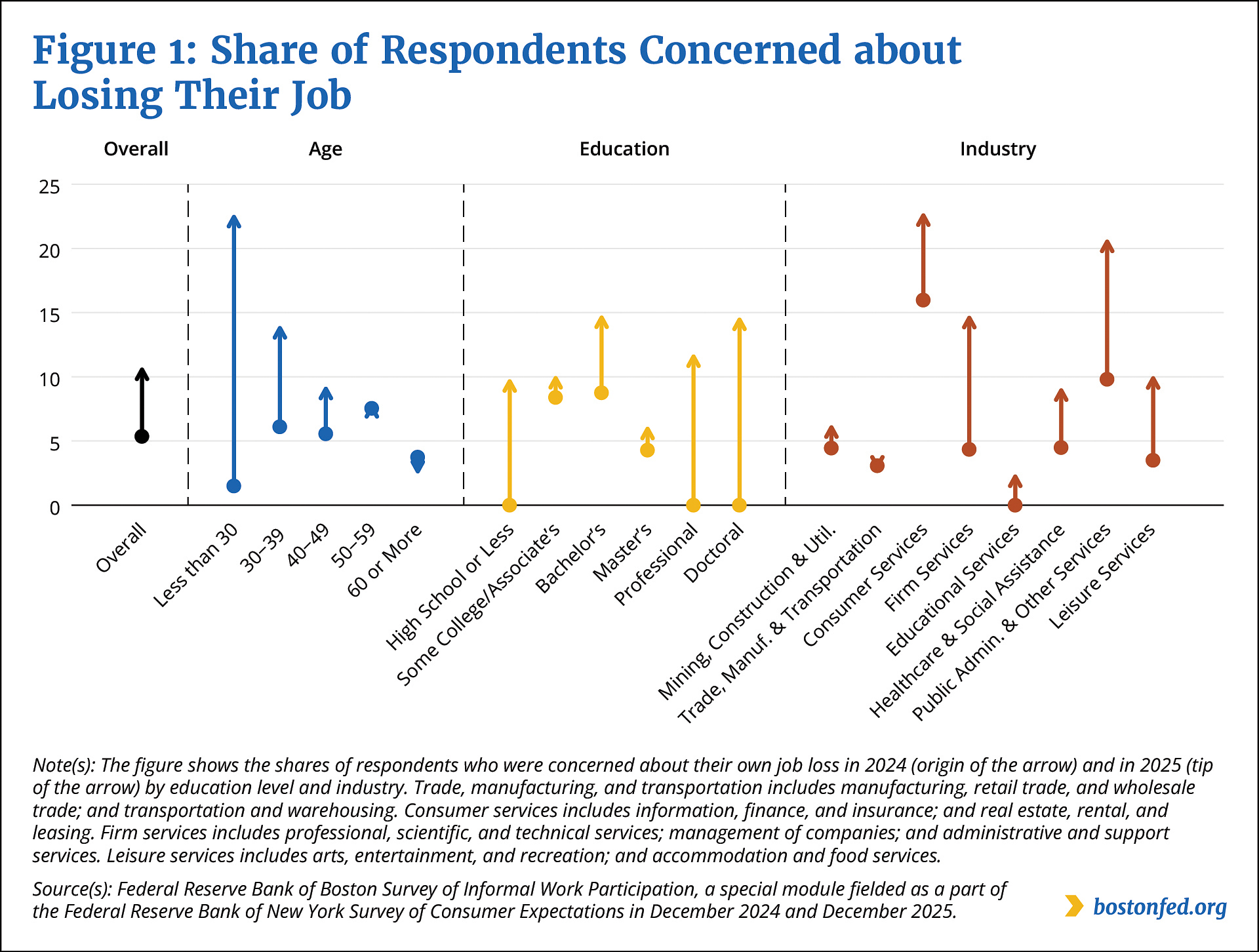
As Figure 1 shows, across education levels, industries, and age groups, workers’ perspectives evolved in 2025, with the overall share of workers concerned about losing their job due to AI nearly doubling—from 5 percent at the end of 2024 to just over 10 percent at the end of 2025.2 Examining worries about a broader set of negative job outcomes, we find that the share of workers in the 2025 survey wave who expressed concerns about job loss or lower wages, or were considering alternative opportunities while also indicating that they could not adapt to AI, was 18 percent, up from approximately 11 percent in 2024.3
Federal Reserve Bank of Boston
Regarding the fear of AI-related job loss among education groups, it is noteworthy that while none of the respondents holding a doctorate or professional degree indicated concerns in 2024, more than 11 percent of professional degree holders and 14 percent of doctorate holders were afraid of losing their job in 2025. In fact, in 2025, doctorate holders and professional degree holders were the respondents most likely to express concern about at least one negative job outcome.
In 2025, the industries with the largest shares of respondents concerned about losing their job were consumer services (23 percent), leisure services (21 percent), and firm services (15 percent). Among all industries, those three also saw the largest increases in such shares; the shares for firm services and leisure services each more than doubled from 2024 to 2025.
Federal Reserve Bank of Boston
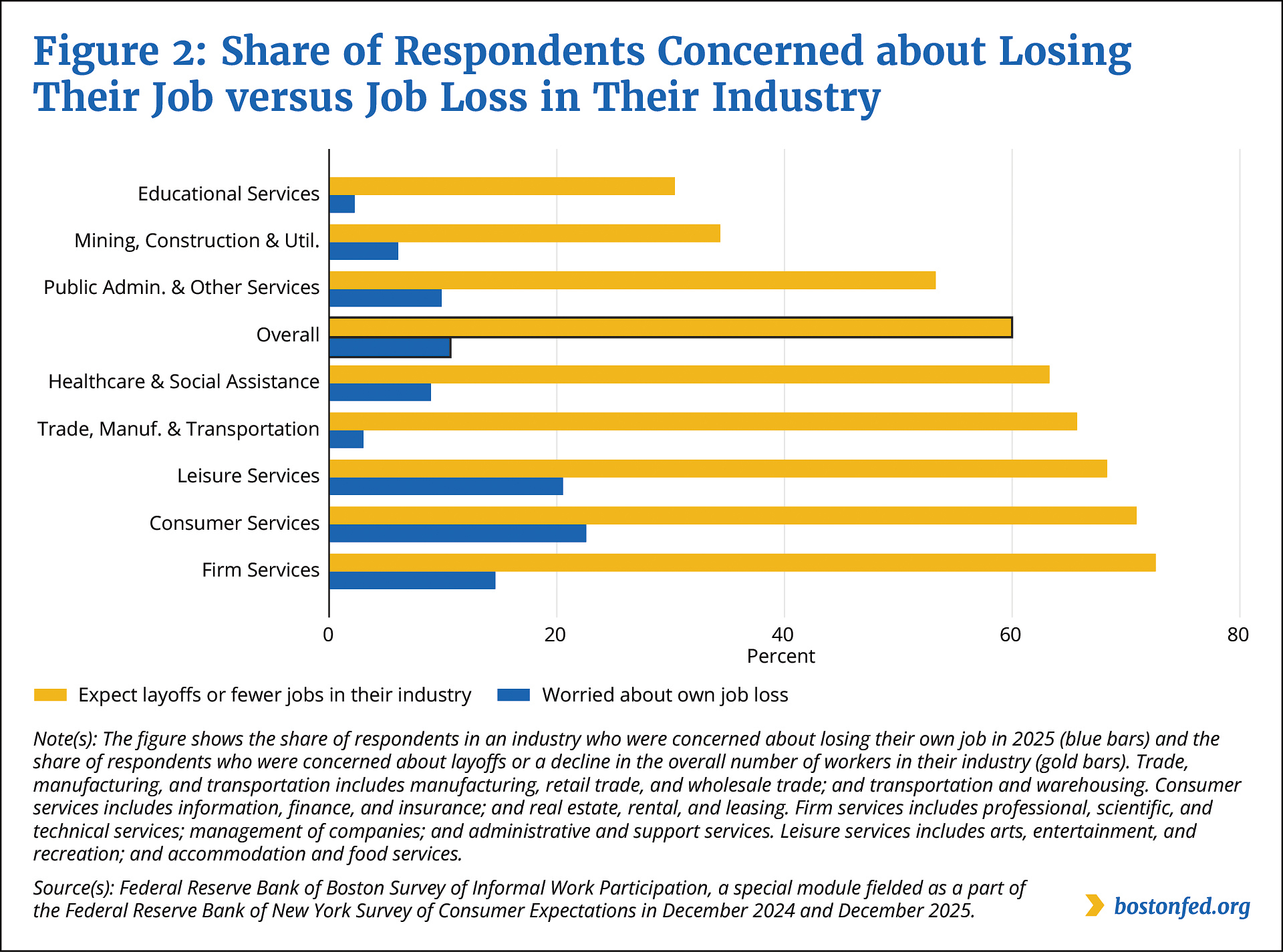
While 10 percent of respondents in the 2025 survey wave indicated that they were concerned about losing their own job due to AI, a much larger share—60 percent—expected AI-related layoffs or a decrease in the total number of workers in their industry, as shown in Figure 2. In other words, many workers believed their job was secure but expected some disruption to their industry. In firm services, leisure services, and consumer services—the industries with the largest shares of respondents concerned about their own jobs—the shares of workers worried about the industry overall were correspondingly elevated relative to other industries. Only small fractions of respondents working in educational services (2 percent) and trade, manufacturing, and transportation (3 percent) were concerned about their own jobs, but the shares anticipating layoffs or fewer jobs in their industry were 30 percent and 65 percent, respectively.
Productivity Boosts from Task Substitution
We believe that the job-related concerns at the personal and industry levels may reflect concerns about AI replacing human labor. That said, large fractions of survey respondents also expected AI to create new opportunities for workers. In fact, in the firm services, leisure services, and consumer services industries, where layoff concerns were the most prevalent, 54, 55, and 37 percent of workers, respectively, expected that new positions would be created due to AI. Central to understanding the effects of AI on the labor market is the open question of whether AI will complement or substitute for workers; that is, will AI augment human workers to generate productivity gains, or will such gains come at the expense of human labor?
The survey explores this issue by including questions about substitution and perceived productivity changes. The questions about substitution are posed at the task level, which aligns with previous research on how technology substitutes for human labor.4 Responses to occupation-level questions may be too coarse because workers may find that AI substitutes for some of their occupation’s tasks while they become more productive in other tasks as a result of AI. Specifically, the substitution-related questions ask whether the respondent relies more on AI suggestions than independent thinking and whether they focus on more challenging tasks while AI handles easier ones.5 With respect to productivity, survey respondents indicated, on a scale from 1 (strongly disagree) to 5 (strongly agree), whether they agreed with the statement, “Since the introduction of AI, I feel more productive at work.”
Federal Reserve Bank of Boston
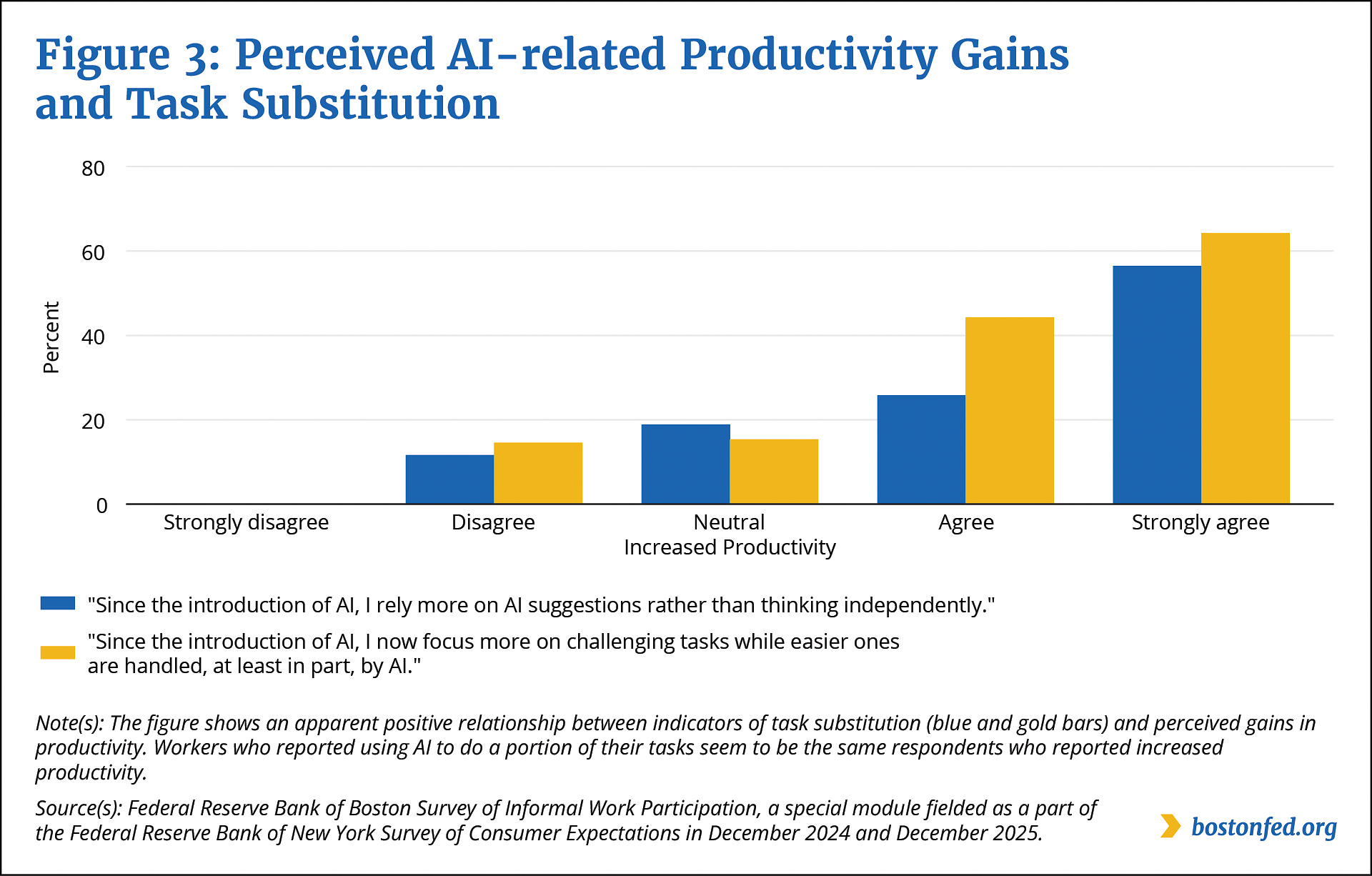
Figure 3 focuses on respondents who had interacted with AI in some capacity and shows that those who reported the greatest perceived productivity gains (agreed strongly that AI had increased their productivity) also tended to report higher levels of task substitution with AI. These results suggest that, instead of being either wholly substituted for or complemented by AI, the workers reaping the most productivity benefits from AI have done so by using it in a portion of their tasks to substitute for their own time—time that they can then devote to other, possibly higher-value tasks.
Job-loss Fears and Perceptions about Productivity Gains
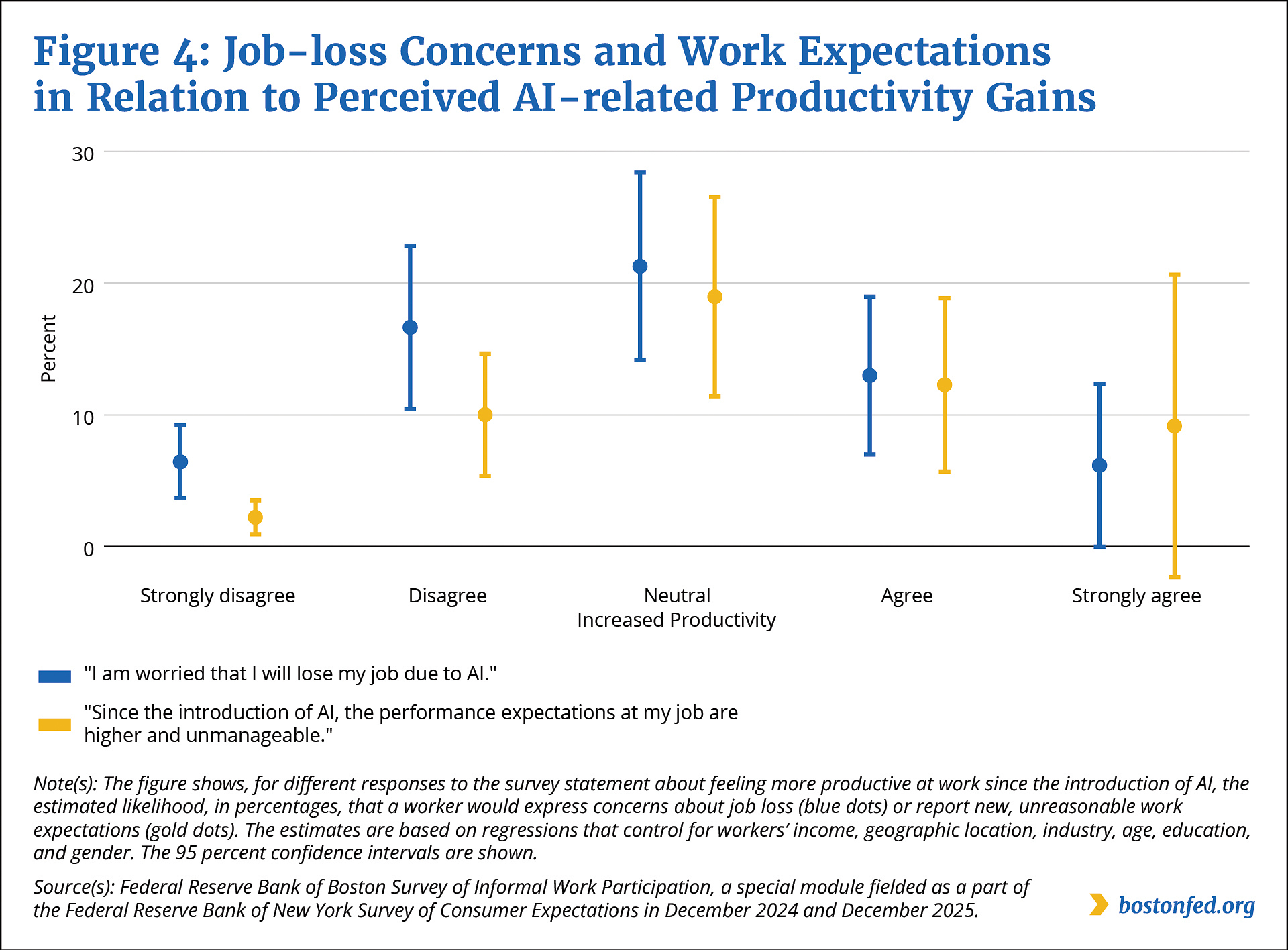
When we examine whether perceived productivity gains are associated with less concern about job loss, we find a hump-shaped relationship in which workers who were neutral on the survey statement about AI increasing their productivity were more likely to be concerned about losing their job. Figure 4 presents the results from our regression analysis. The blue dots depict estimates of the relationship between perceived productivity gains and concerns about job loss after we control for other worker characteristics that may relate to both productivity and job loss, including income, geographic location, industry, age, education, and gender.
Federal Reserve Bank of Boston
Respondents who strongly disagreed with the statement that their productivity had increased due to AI represent 47 percent of the regression sample—those who work and have exposure to AI. Among those respondents, the estimated likelihood of being concerned about job loss is 6.4 percent. The roles of workers in this group likely are difficult to integrate with AI. As Figure 3 shows, workers who didn’t perceive any productivity gains from AI also didn’t replace any tasks with AI.
A similar sense of relatively greater job security seems to prevail among the 6 percent of the regression sample who strongly agreed that their productivity had increased due to AI. Respondents in this group are estimated to have only a 6.1 percent likelihood of expressing concerns about job loss. The results suggest that workers perceiving the strongest productivity gains from AI also feel more secure in their job prospects because they have successfully leveraged the technology to the benefit of their employers.
By contrast, the workers who had a neutral response to the statement about productivity gains related to AI (21 percent of the regression sample) had a 21.2 percent likelihood of expressing concerns about losing their job. These workers likely were implementing AI and using it to perform some tasks, but they had not managed to achieve productivity gains and were therefore naturally the most likely to fear for their job.
Our estimates depicted in gold in Figure 4 indicate that work expectations are a potential driver of such fears. These estimates show that the relationship between perceived productivity gains and new, unreasonable work expectations is also hump shaped. At an estimated rate of 19 percent, workers with a neutral response to the statement about AI-related productivity gains were the most likely to indicate that they had faced new and unmanageable work expectations since the introduction of AI. By contrast, workers who strongly agreed with the statement about AI-related productivity gains or who strongly disagreed with it were less likely—estimated rates of 9 and 2 percent, respectively—to say they faced new and unmanageable work expectations. Together, these results present a consistent narrative that perceived productivity is a defining feature of workers’ experiences with AI that helps us identify sectors of the labor force with the strongest fears of job loss, possibly related to a feeling of falling behind at work.
AI-related Productivity and Wage Pressures
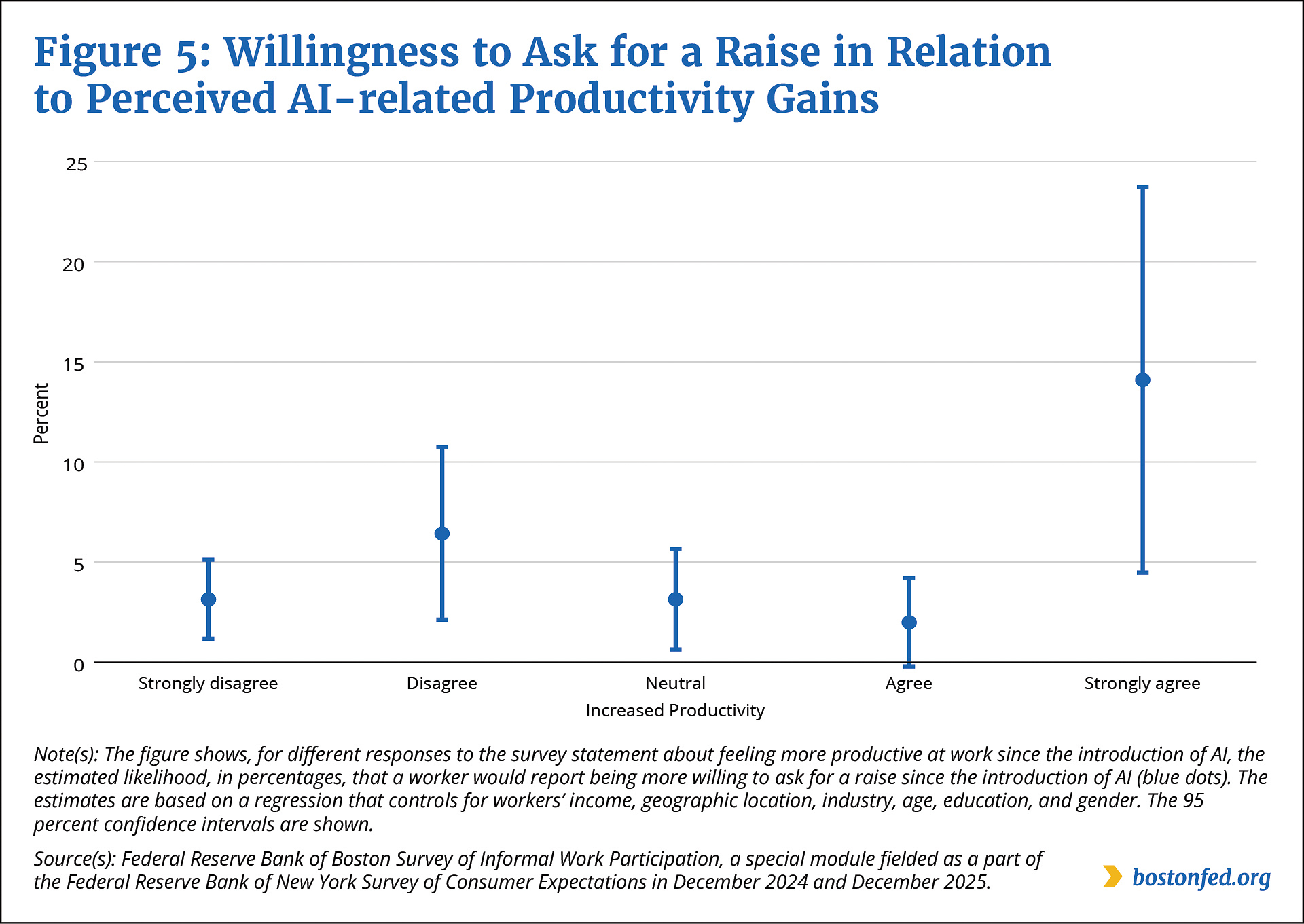
According to the estimates from our regression analysis of how perceived productivity and job security relate to wage pressures, if a worker believes they have used AI to become more productive, they not only feel more secure in their job but are also more likely to ask for a raise. As Figure 5 shows, workers who strongly agreed with the survey statement about feeling more productive at work since the introduction of AI had an estimated 14 percent likelihood of indicating that they were more likely to ask for a raise, compared with an estimated likelihood of only 1.9 to 6.4 percent for the four lowest categories of perceived productivity gains.
Federal Reserve Bank of Boston
These results align with the apparent relationship between AI adoption and perceived productivity gains presented in Figure 3. The adoption of AI has likely had minimal impact on the jobs of workers who strongly disagreed with the statement that their productivity increased due to AI, which is consistent with this group’s lack of task substitution. While these workers may feel secure in their current line of work, AI has not provided them with any additional reason to ask for higher wages.
Workers who expressed a neutral attitude toward the statement that their productivity had grown due to AI or mildly agreed or disagreed with it appear to have had more experience with AI and were engaging more in task substitution (compared with those who strongly disagreed with the statement (Figure 3). But as Figure 4 shows, they were also the most likely to fear for their jobs and, therefore, were also unlikely to believe they had negotiating power over their wages.
By contrast, workers at the very high end of the range of perceived productivity gains were relatively more optimistic about the impact of AI on their jobs—that is, less likely to be concerned with job loss or experiencing new, unmanageable work expectations (Figure 4). Consistent with this optimism, we estimate that they were more than four times (14 percent versus 3.1 percent for workers with a neutral attitude) more likely to ask for a raise in the next 12 months due to AI (Figure 5), possibly because they perceived relatively more negotiating power over their wages.
These results outline a mechanism for generating upward wage pressure, whereby the most productive workers are rewarded for AI-related gains. However, the broader implications for AI-related upward wage pressures are tempered by the fact that only a small share of respondents (6 percent) reported the strongest productivity gains.
Endnotes
- See Bracha and Tang (2025).
- We classify workers as being concerned about job loss if they responded with a rating of 4 or 5 when asked, on a scale from 1 (not at all) to 5 (very much), how much they agreed with the statement, “I am worried that I will lose my job due to AI.”
- Acknowledging that workers may consider alternative work opportunities due to either downsides or upsides of AI, we further condition this response on whether respondents say they could adapt to AI on their own or with training. When a respondent was considering alternative opportunities and could not adapt, we considered this a negative job outcome.
- Papers that advocate for focusing on tasks rather than occupations when considering whether new technologies substitute for or complement human labor include Autor, Levy, and Murnane (2003), Acemoglu and Autor (2011), Acemoglu and Restrepo (2019), and Acemoglu and Restrepo (2022).
- Results from the Census Bureau’s Business Trends and Outlook Survey (BTOS) validate results from our survey. The share of BTOS firms in an industry indicating that AI has performed tasks previously done by employees is positively correlated with the share of our survey’s respondents working in that industry who expected greater AI use for employee tasks. Similarly, the share of BTOS firms reporting that AI has supplemented the work done by employees in the last six months is positively correlated with the share of our survey’s respondents who reported an AI-related increase in productivity. In both cases, the correlation coefficient represents a statistically significant relationship. These results are presented in Appendix Figures A and B.
References
Acemoglu, Daron, and David Autor. 2011. “Skills, Tasks and Technologies: Implications for Employment and Earnings.” In Handbook of Labor Economics Volume 4, Part B, edited by David Card and Orley Ashenfelter, 1043–1171. Amsterdam, the Netherlands: Elsevier.
Acemoglu, Daron, and Pascual Restrepo. 2019. “Automation and New Tasks: How Technology Displaces and Reinstates Labor.” Journal of Economic Perspectives 33(2): 3–30.
Acemoglu, Daron, and Pascual Restrepo. 2022. “Tasks, Automation, and the Rise in U.S. Wage Inequality.” Econometrica 90(5): 1973–2016.
Autor, David H., Frank Levy, and Richard J. Murnane. 2003. “The Skill Content of Technological Change: An Empirical Exploration.” The Quarterly Journal of Economics 118(4): 1279–1333.
Bracha, Anat, and Jenny Tang. 2025. “Shaping the Future of Work: Workers’ Optimism and Pessimism about AI,” Federal Reserve Bank of Boston Current Policy Perspectives 25-16.
Humlum, Anders, and Emilie Vestergaard. 2025. “Still Waters, Rapid Currents: Early Labor Market Transformation under Generative AI,” NBER Working Paper 33777.

 About the Authors
Anat Bracha,
Federal Reserve Bank of Boston
Anat Bracha is an associate professor in the Banking and Finance Department at the Hebrew University of Jerusalem and a visiting scholar with the Federal Reserve Bank of Boston Research Department. .
Email: Anat.Bracha@mail.huji.ac.il
Rees Hagler,
Federal Reserve Bank of Boston
Rees Hagler is a senior research associate in the Federal Reserve Bank of Boston Research Department.
Jenny Tang,
Federal Reserve Bank of Boston
Jenny Tang is a vice president and economist in the Federal Reserve Bank of Boston Research Department.
Email: Jenny.Tang@bos.frb.org
Resources
Site Topics
Keywords
- AI ,
- Artificial Intelligence ,
- productivity ,
- unemployment ,
- wage pressures
JEL Codes
- C83 ,
- D84 ,
- O33 ,
- J24 ,
- E24
Citation
Bracha, Anat, Rees Hagler, and Jenny Tang. 2026. “Workers’ Perspectives on Artificial Intelligence: Productivity Gains and Job-loss Fears.” Federal Reserve Bank of Boston Current Policy Perspectives 26-8.