How Much Did Labor Productivity Gains Offset the Inflationary Impact of the 2025 Tariffs? 


Federal Reserve Bank of Boston

The views expressed herein are solely those of the authors and should not be reported as representing the views of the Federal Reserve Bank of Boston, the principals of the Board of Governors, or the Federal Reserve System.
In 2025, the average realized tariff on US imports rose from about 2.5 percent to about 10 percent. The resulting increase in US firms’ input costs—the expenses a business incurs to acquire the goods or materials it needs to produce its final products—had the potential to raise inflation significantly (Barbiero and Stein 2025). Barbiero, Silva, and Stein (2026) and Minton, Ray, and Somale (2026) find evidence that this increase in costs, indeed, has been at least partly passed through into consumer prices. Results from a survey of US small and medium-sized businesses presented in Andrade et al. (2025) also indicate that firms have passed through tariff-induced cost increases into prices. Given those findings, the new trade policy could explain why inflation remained significantly above the Federal Reserve’s 2 percent target in 2025.
On the other hand, as the tariffs took hold in 2025, US workers’ productivity grew. When workers are more productive, companies can maintain their output using fewer work hours. So, these productivity gains could have helped companies reduce their costs and thereby mitigate inflationary pressures from the tariffs.
Sign up for Research Department Updates.
In this brief, we study the extent to which productivity gains may have offset the tariff-driven cost increases. We do so by constructing measures of sectoral increases in input costs induced by the new tariffs and compare them with sectoral labor productivity gains. The cost increases vary across sectors because sectors are differentially dependent on foreign goods. Likewise, productivity gains vary across sectors.
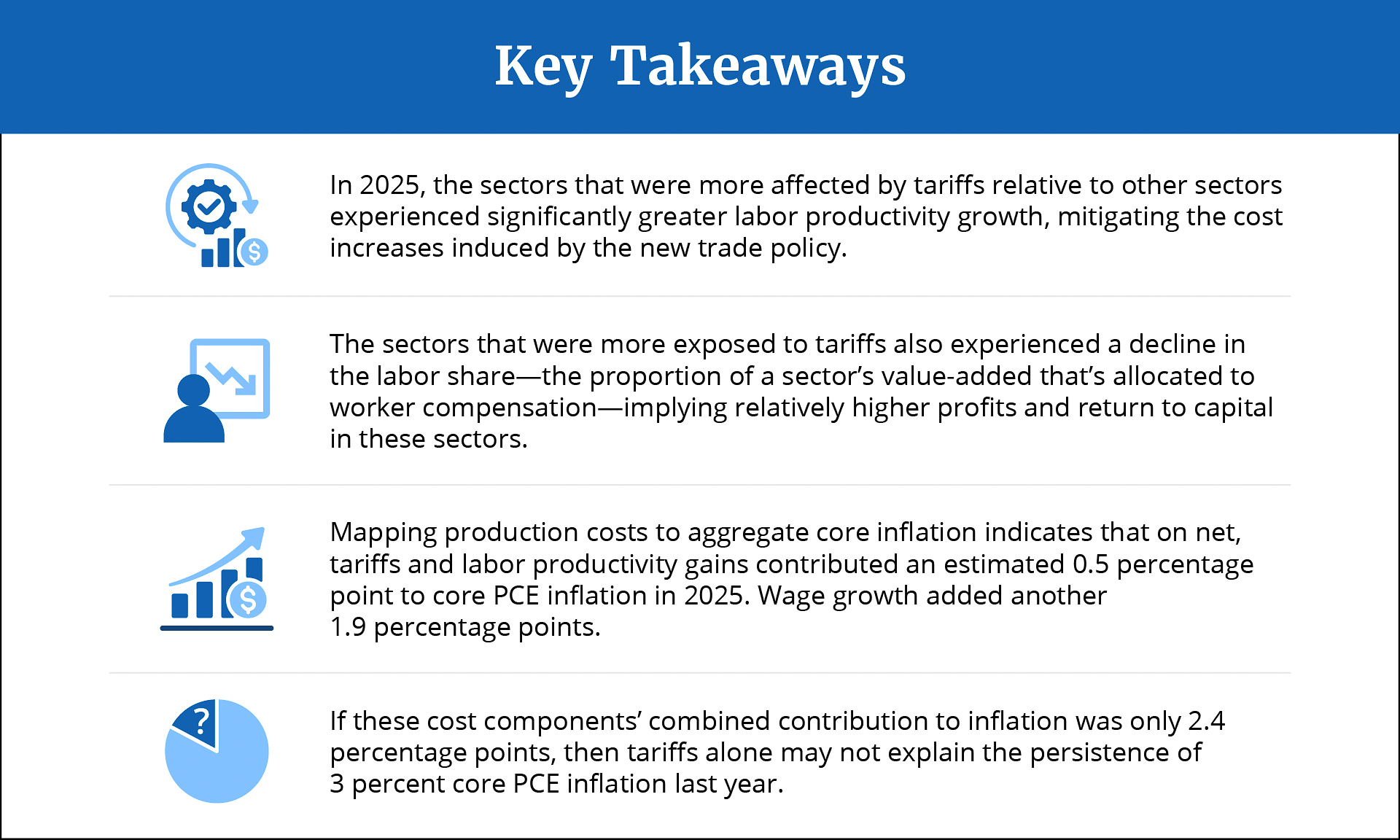
We provide evidence that industries in which tariffs induced higher costs in 2025 also experienced greater labor productivity growth, which helped them mitigate those higher costs.
We also document that these industriesʼ labor productivity growth came from a decline in hours worked and that growth in their real value-added—the inflation-adjusted value of production minus intermediate inputs—remained constant.
Additionally, we find that the labor share—the proportion of a sector’s value-added that’s allocated to worker compensation—fell relatively more in sectors that were more exposed to tariffs. This result implies that in these sectors, productivity gains were not always accompanied by real wage increases and therefore contributed to lower production costs.
Finally, we assess how the net impact of the new tariffs and productivity gains affected consumer prices. We find that, on net, tariff increases and productivity gains contributed only 0.5 percentage point to core PCE inflation.1 Productivity gains thus strongly offset the increase in consumer prices induced by tariffs. These results suggest that the new trade policy alone cannot explain the persistence of 3 percent inflation in 2025 and that other inflationary factors also may have been at play.
Tariffs Increased Input Costs across All Sectors
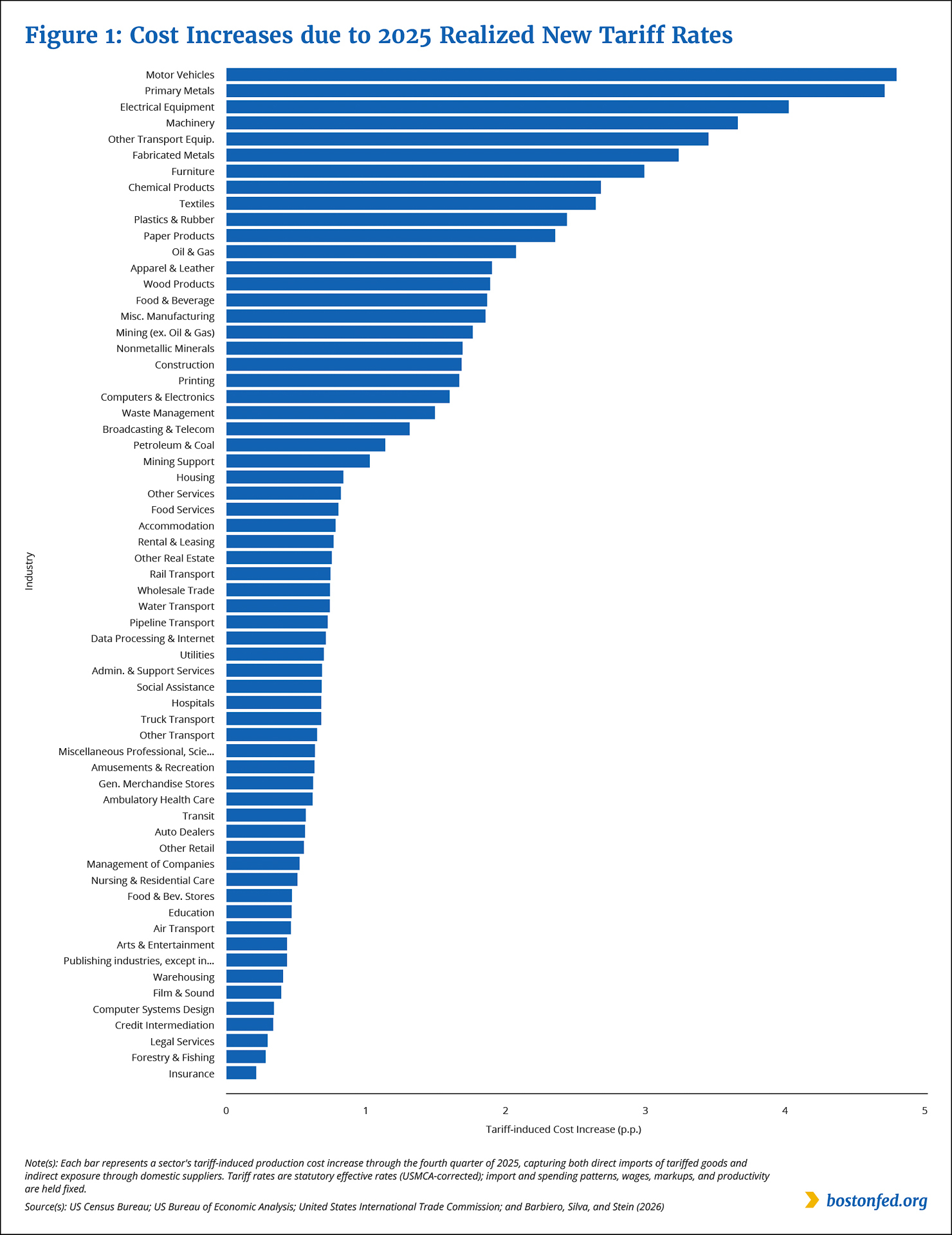
Figure 1 shows the implied production cost increases by sector due to the 2025 tariffs, that is, how much larger the cost increases were, in percentage points, with the new tariffs, holding everything else constant. We computed the increases by following the method presented in Barbiero, Silva, and Stein (2026), which uses input–output tables from the US Bureau of Economic Analysis that detail the supply-chain relationship between 402 commodity-by-industry categories in the United States. The model allows us to track how tariffs spread through supply chains. For example, when tariffs make steel more expensive, it raises costs for carmakers, which then raises car prices. The model captures these ripple effects while holding other factors, including wages and productivity, constant.2
Federal Reserve Bank of Boston
As expected, the tariff-induced production cost increases are larger for goods sectors, including motor vehicles, primary metals, and electrical equipment. Nonetheless, due to the indirect effects induced by the structure of the US supply chain, the impact of tariffs on services sectors is non-negligible. For instance, broadcasting and telecommunications saw a 1.30 percentage point increase in costs due to tariffs because imports account for 7.5 percent of the sector’s total costs.
When we aggregate across all sectors, we obtain a total tariff-induced cost increase for domestic producers of 1.1 percentage points.3
Labor Productivity Improved in Many Sectors in 2025
The impact of tariffs notwithstanding, other forces also shape production costs. An important one is productivity growth. When companies become more productive, they need fewer resources to manufacture the same volume of products.
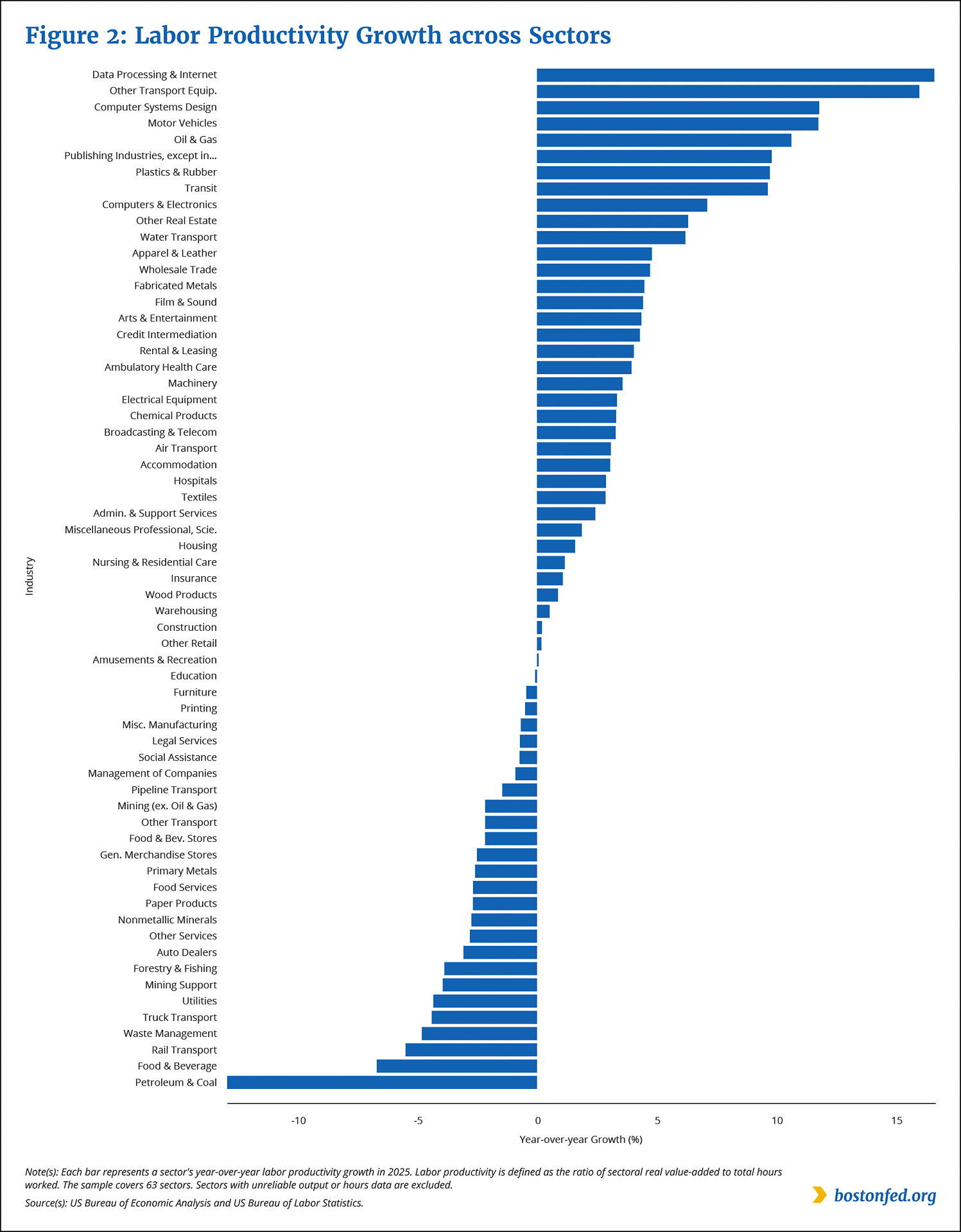
Using sectoral employment data from the US Bureau of Labor Statistics (BLS) and US Bureau of Economic Analysis (BEA) sectoral data, we compute the average labor productivity growth in 2025 for 63 sectors. We define labor productivity as the ratio of sectoral real value-added to total hours worked. Figure 2 depicts the results, showing that 37 of the 63 industries experienced positive growth.4
Federal Reserve Bank of Boston
As the figure shows, there was substantial heterogeneity across industries. Data processing and motor vehicles saw the greatest labor productivity improvement in 2025 (16.64 and 11.78 percent, respectively). The largest decline in labor productivity was in the commodity sectors, including petroleum and coal, and forestry and fishing, where real sectoral value-added per hour worked fell 12.98 and 3.88 percent, respectively.
By combining our sectoral productivity results with data from the BEA input–output tables, we can estimate the impact of the labor productivity gains on sectoral unit costs, taking into account that direct productivity gains in one industry can have indirect effects on others, as they propagate downstream through lower intermediate input costs. When we aggregate the impact of sectoral labor productivity growth on per-unit costs across all sectors, we obtain an overall reduction in production costs of 1.3 percent (see the appendix for details).
Sectors More Exposed to Tariffs Experienced Faster Labor Productivity Growth
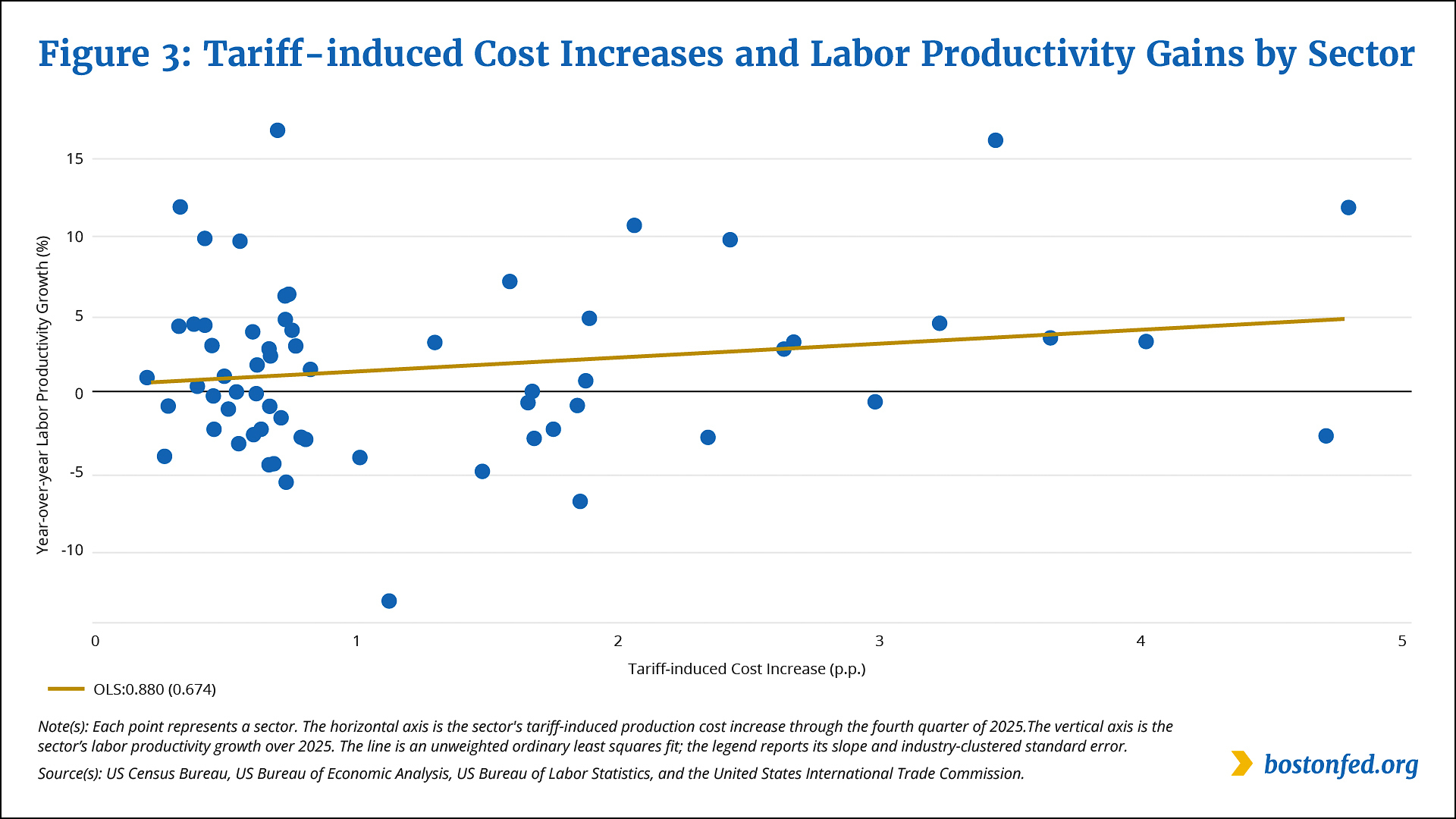
As a cost-cutting force, labor productivity gains may offset tariff-induced cost increases, but only if the tariff increases and productivity gains occur in the same sectors. That is what happened in 2025, as Figure 3 shows.
Federal Reserve Bank of Boston
The figure illustrates how tariff-induced cost changes correlated with labor productivity growth in 2025. The solid line depicts the fitted line of a linear regression between the two variables, representing their relationship based on the data. As indicated by the slope of the line, the relationship is positive on average, meaning that industries in which tariffs created stronger upward pressure on costs relative to other industries were, on average, the industries in which labor productivity growth was relatively greater in 2025. The results suggest that labor productivity gains could have helped offset the cost increases induced by the new trade policy.
Sectors More Exposed to Tariffs Experienced a Drop in Their Labor Share
Labor productivity gains can be accompanied by an increased wage bill if more workers are hired, more hours are used, wages increase, or any combination of the three. In any of those cases, improved productivity would provide less of an offset to tariff-induced cost increases. However, as we show, the sectors that were more exposed to the 2025 tariffs compared with other sectors did not experience a relative increase in their wage bill.
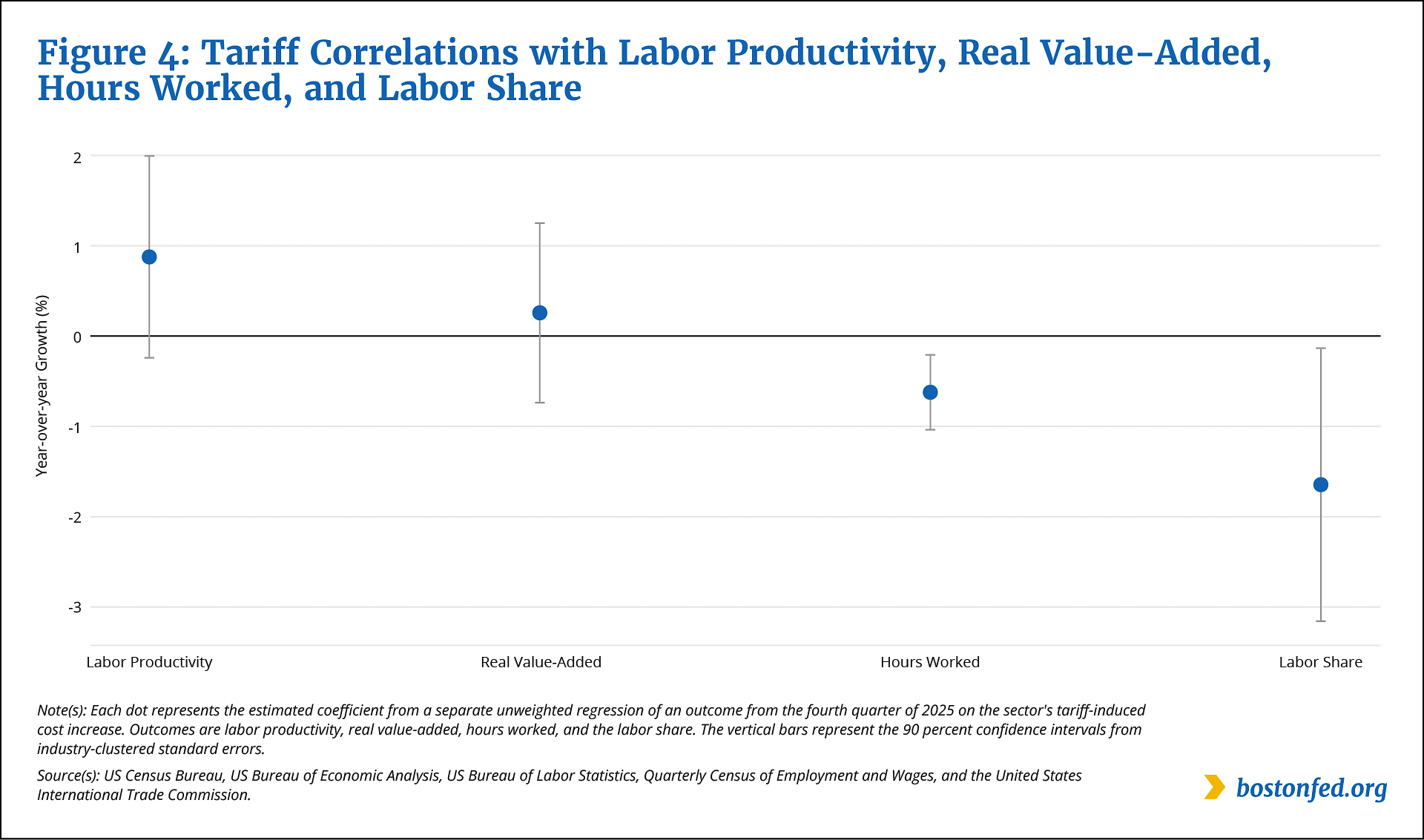
As noted, we define labor productivity as the ratio of sectoral real value-added to total hours worked. We now assess whether the increased productivity in the sectors with larger tariff-induced cost increases was due mainly to real value-added, additional hours worked, or both. Figure 4 presents the results from our regression analysis.
Federal Reserve Bank of Boston
As the figure shows, the tariff-induced cost increases in 2025 are not significantly correlated with growth in real value-added and negatively correlated with hours worked. These findings indicate that the sectors in which tariffs had a stronger impact on costs also saw real value-added growth remain relatively constant and employment, more precisely hours worked, decline. Thus, the reduction in hours contributed to greater labor productivity growth.
As for whether higher wages reduced the declines in production costs, we find a negative relationship between tariff-induced cost increases and the labor share; that is, the sectors with greater tariff-induced cost increases experienced a decline in the labor share. This finding implies that real wage growth did not match labor productivity gains in these sectors, thus freeing a cost-offsetting force that may have been directed to other factors of production or, possibly, higher markups.5
Our evidence is not causal. The correlations we find in the data could reflect that tariffs impacted sectors that were already experiencing a multiyear trend in improved labor productivity and shrinking labor share. Another potential story could be that tariffs forced unproductive firms that were highly dependent on foreign goods out of the market. This would imply that only the most productive firms remain, and that markups could have increased due to reduced competition. Another possibility is that businesses invested in new equipment or new production processes to reduce labor costs and compensate for tariff-induced input cost increases.
Tariff-induced Cost Increases Cannot Fully Explain Why Inflation Did Not Decline in 2025
Our results have important implications for understanding what drove US inflation in 2025. Observers have frequently pointed to tariff-induced cost pressures to explain why inflation remained elevated. However, our findings show that labor productivity gains substantially offset these cost increases. This raises a critical question: what was the net impact of both tariffs and productivity gains on aggregate consumer inflation in 2025?
We answer that question by using the sectoral unit-cost changes from tariffs and labor productivity gains that we discussed earlier. We also look at unit-cost changes due to nominal wage growth. We then use bridge tables from the BEA to map how sectoral unit costs translate into personal consumption expenditures. Our benchmark assumes a full pass-through of production costs into prices.
Federal Reserve Bank of Boston
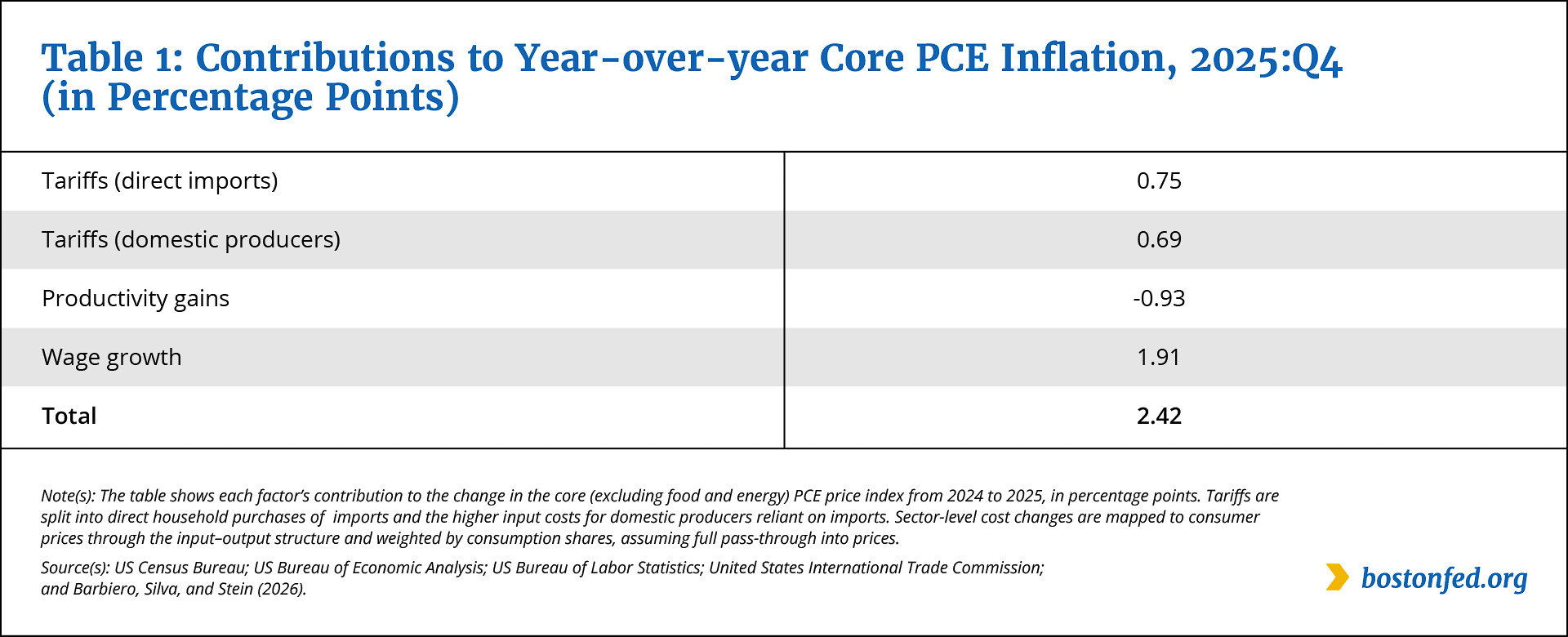
Table 1 presents the effects of each of these cost components—tariffs, productivity gains, and wage increases—on core PCE inflation. As in Barbiero, Silva, and Stein (2026), we break down the impact of tariffs into their effects through goods and services that are directly imported and through those that are produced domestically. Core PCE inflation was roughly 3 percent in 2025. According to our estimates, wage growth contributed 1.9 percentage points, and the net contribution of the two tariff components (1.4 percentage points) and labor productivity gains (–0.9 percentage point) was 0.5 percentage point, for a total of 2.4 percent. So, 0.6 percentage point in realized core PCE inflation is left unexplained.
Overall, while tariffs were a special factor that contributed to price increases in 2025, given labor productivity gains, it is hard to explain why inflation was 3 percent by resorting to only this new policy. Indeed, given labor productivity gains, inflation should have been closer to 2 percent. This suggests that other factors, whose effects on inflation may be less transient than those of tariffs, could have been significant contributors to inflation as well.
Endnotes
- Headline PCE inflation is the Federal Reserve’s preferred inflation gauge. Core PCE inflation excludes movements explained by food and energy prices, which are usually volatile.
- These calculations assume the full pass-through of marginal costs into input prices in percentage terms. See Barbiero, Silva, and Stein (2026) for more details. Importantly, we keep input and trade shares fixed at their 2024 levels, but the tariff rate itself is the statutory effective rate for each HS10 commodity, USMCA-corrected, from the US Census Bureau Merchandise Trade Imports. This realized rate reflects duties actually collected, not headline enacted rates. As Gopinath and Neiman (2026) emphasize, realized rates run below enacted ones due to exemptions and purchasing delays.
- Each sector is weighted by its share of final consumer spending, proxied by its 2024 PCE core value weight. See the appendix for details.
- Such an outcome is not limited to 2025. Garga, Olivei, and Wang (2024) document that in many industries, labor productivity grew over the 2021–2023 period.
- The drop in costs due to productivity increases could partly explain why Mehrotra and Waugh (2026) find that the tariff-induced cost increases did not correlate with sectoral core goods price inflation in 2025.
References
Andrade, Philippe, Alexander Dietrich, John Leer, Xiao Lin, Raphael Schoenle, Jenny Tang, and Egon Zakrajsek. 2025. “Who Will Pay for Tariffs? Businesses’ Expectations about Costs and Prices.” Federal Reserve Bank of Boston Current Policy Perspectives 25-13.
Barbiero, Omar, and Hillary Stein. 2025. “The Impact of Tariffs on Inflation.” Federal Reserve Bank of Boston Current Policy Perspectives 25-2.
Barbiero, Omar, Alvaro Silva, and Hillary Stein. 2026. “The Contribution of Imports to Domestic Prices.” Working paper.
Garga, Vaishali, Giovanni P. Olivei, and J. Christina Wang. 2024. “Productivity Improvements and Markup Normalization Can Support Further Wage Gains without Inflationary Pressures.” Federal Reserve Bank of Boston Current Policy Perspectives 24-5.
Gopinath, Gita, and Brent Neiman. 2026. “The Incidence of Tariffs: Rates and Reality.” National Bureau of Economic Research Working Paper 34620.
Mehrotra, Neil, and Michael E. Waugh. 2026. “Tariffs Can’t Explain Rising Goods Inflation.” Federal Reserve Bank of Minneapolis.
Minton, Robert, Madeleine Ray, and Mariano Somale. 2026. “Detecting Tariff Effects on Consumer Prices in Real Time — Part II.” FEDS Notes. Washington: Board of Governors of the Federal Reserve System.

 About the Authors
Philippe Andrade,
Federal Reserve Bank of Boston
Philippe Andrade is a vice president and economist in the Federal Reserve Bank of Boston Research Department.
Email: Philippe.Andrade@bos.frb.org
Omar Barbiero,
Federal Reserve Bank of Boston
Omar Barbiero is a senior economist in the Federal Reserve Bank of Boston Research Department.
Email: Omar.Barbiero@bos.frb.org
Alvaro Silva,
Federal Reserve Bank of Boston
Alvaro Silva is an economist in the Federal Reserve Bank of Boston Research Department.
Email: Alvaro.Silva@bos.frb.org
Acknowledgments
The authors thank Maxwell Cozean for superb research assistance.
Resources
Site Topics
Keywords
- tariffs ,
- inflation ,
- labor productivity ,
- input-output linkages ,
- production costs ,
- Trade policy ,
- supply chains
JEL Codes
- E31 ,
- F13 ,
- E24 ,
- D24
Citation
Andrade, Philippe, Omar Barbiero, and Alvaro Silva. 2026. “How Much Did Labor Productivity Gains Offset the Inflationary Impact of the 2025 Tariffs?” Federal Reserve Bank of Boston Current Policy Perspectives 26-7.