Worker survey: AI-related job-loss fears up sharply, more workers expect to save less 
Boston Fed researchers find job-loss worries may be compounded by affordability concerns

Arianna Azevedo/Federal Reserve Bank of Boston



Concerns about losing a job to artificial intelligence grew sharply among U.S. workers from 2024 to 2025, and those fears affected households’ expectations about saving money in the year ahead, according to two new Current Policy Perspectives briefs from the Federal Reserve Bank of Boston.
Both briefs are based on responses to a special module of the New York Fed’s Survey of Consumer Expectations that was conducted in December 2024 and again in December 2025. The SCE is a nationally representative monthly internet-based survey of a rotating panel of approximately 1,300 U.S. household heads.
The first brief, “Workers’ Perspectives on Artificial Intelligence: Productivity Gains and Job-Loss Fears,” was written by Boston Fed vice president and economist Jenny Tang, visiting scholar Anat Bracha, and senior research associate Rees Hagler. The second brief, “How Concerns about Artificial Intelligence and Affordability Have Affected Workers’ Expectations about Saving,” was written by Boston Fed vice president and economist Daniel Cooper, senior research associate Cecelia Chapleau, and Hagler.
In the first brief, Tang, Bracha, and Hagler find that in the year between the two survey waves, the overall share of workers concerned about losing their job due to AI doubled, from 5% to just over 10%.
The rise in job-loss worries was not confined to any single group of workers. “This increase is evident across nearly all industries, educational levels, and age groups,” the authors write.
They note that the most striking shift in perceived job security occurred among workers with advanced degrees. “While none of the respondents holding a doctorate or professional degree indicated concerns in 2024, more than 11% of professional degree holders and 14% of doctorate holders were afraid of losing their job in 2025,” they write.
Fear of personal job loss was far less common than worry about industry-wide disruption. The authors note that “while 10% of respondents in the 2025 survey wave indicated that they were concerned about losing their own job due to AI, a much larger share – 60% – expected AI-related layoffs or a decrease in the total number of workers in their industry.”
Productivity gains from AI tied to perceptions of job security
According to the authors’ analysis of the survey results, the workers most likely to feel secure in their jobs – that is, the least likely to express job-loss concerns – came from seemingly opposite circumstances. They either strongly agreed or strongly disagreed with the survey question asking if their productivity had increased due to AI.
The authors write that the roles of workers in the group that strongly disagreed “likely are difficult to integrate with AI.” By contrast, workers who strongly agreed “have successfully leveraged the technology to the benefit of their employers.”
The authors’ analysis also indicates that workers who were neutral about whether AI had helped them become more productive were the most likely to express job-loss concerns.
“These workers likely were implementing AI and using it to perform some tasks,” the authors write, “but they had not managed to achieve productivity gains and were therefore naturally the most likely to fear for their jobs.”
Workers who had experienced the greatest productivity gains were also the most likely to ask for a raise. The authors report that respondents who strongly agreed that their productivity had increased “had an estimated 14% likelihood of indicating that they were more likely to ask for a raise, compared with an estimated likelihood of only 1.9% to 6.4% for the four lowest categories of perceived productivity gains.”
However, the authors add that “the broader implications for AI-related upward wage pressures are tempered by fact that only a small share of respondents (6%) reported the strongest productivity gains.”
AI-related job-loss fears, affordability concerns result in lower saving expectations
In the second brief, Cooper, Chapleau, and Hagler use the survey results to examine how AI-related job worries have affected U.S. workers’ expectations about saving money. The results, the authors note, run counter to a common assumption in economics.
“We might anticipate that survey respondents who were worried about losing their job due to AI would report that they expected to save more as a hedge,” the authors write, referring to the traditional idea of precautionary saving – saving for a rainy day. “Instead, we find a negative relationship between AI-related job-loss concerns and saving expectations, in which worried workers expected to save less.”
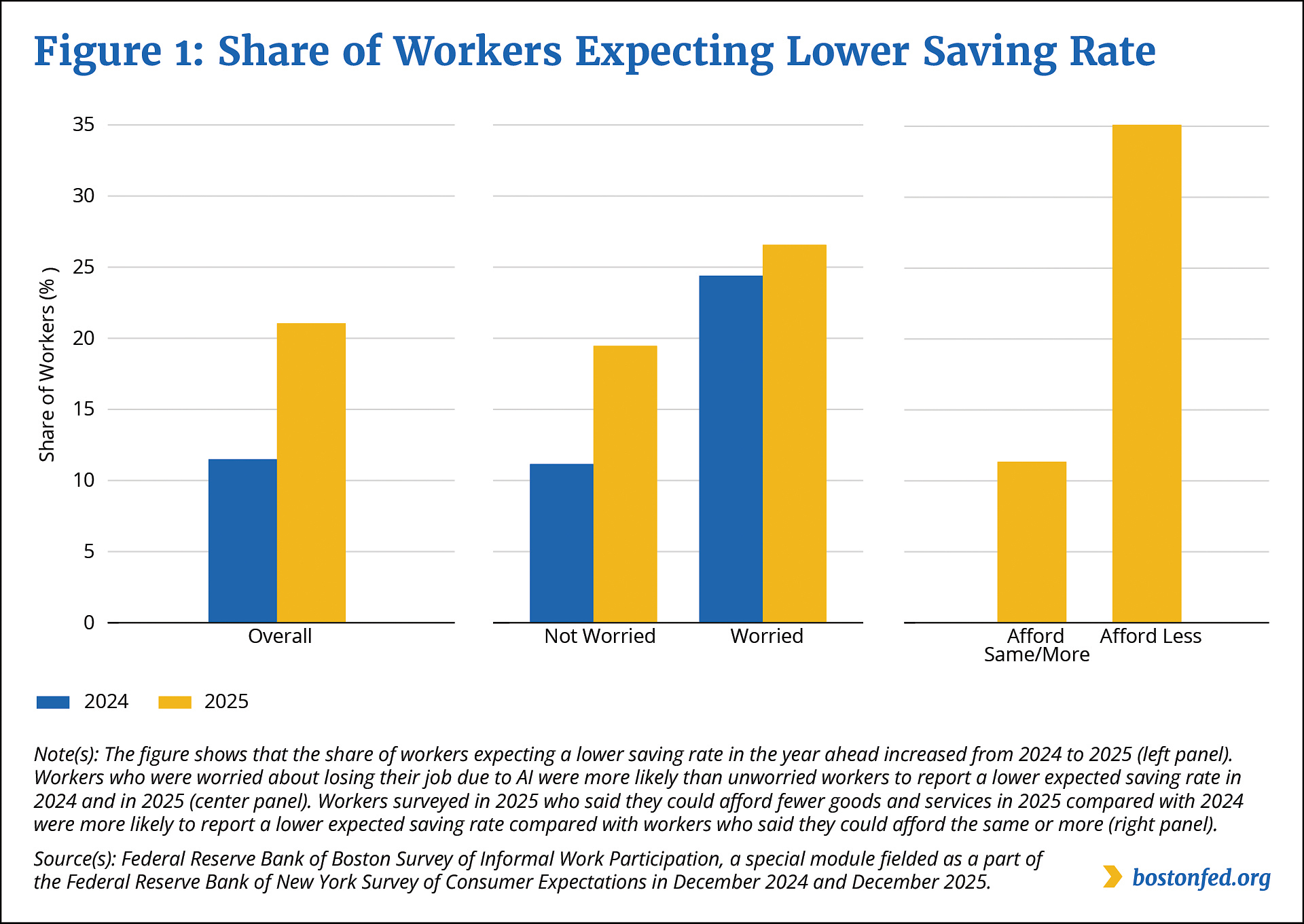
According to the survey results, the overall share of workers expecting to save a smaller share of their earnings (a lower saving rate) over the next 12 months nearly doubled from 11% at the end of 2024 to 21% at the end of 2025. The survey also shows that in both years, workers who were worried about losing their job due to AI were significantly more likely than unconcerned workers to expect their saving rate to decline (Figure 1).
“On the surface, this suggests that worries about AI-related job loss did not lead to increased precautionary saving,” the authors note. “However, these individuals may already have been experiencing or expecting to experience some financial distress that limited their ability or desire to save.”
Federal Reserve Bank of Boston
Specifically, the authors find that existing concerns about affordability may have compounded the effect of AI-related job-loss fears on saving expectations.
In the 2025 wave, survey participants were asked whether they could afford the same quality and quantity of goods and services that they had purchased in 2024. Respondents who reported affordability challenges and AI-related job-loss concerns were twice as likely to expect to save less in the coming year. That’s compared with respondents who said they could afford less and were not worried about AI-related job loss.
“This suggests that worries about affordability and AI-related job loss reinforced each other in terms of anticipated saving,” the authors’ write. “Workers with both concerns may be the most likely to expect their financial situation to deteriorate further.”
Certain demographic groups of workers were especially likely to expect to save less in the year ahead. The authors find that among worried workers, men were more likely than women to expect a lower saving rate. Also, workers older than 45 were more likely than younger workers to have such expectations.
However, the authors write, “experience with AI in the workplace seems to have substantially tempered the effect of AI-related worries on older workers’ saving expectations.”
Media Inquiries?
Contact our media relations team. We connect journalists with Boston Fed economists, researchers, and leadership and a variety of other resources.

 About the Authors
Larry Bean is the executive editor in the Research department at the Federal Reserve Bank of Boston.
Email: Lawrence.Bean@bos.frb.org
Site Topics
Keywords
- generative AI ,
- AI ,
- personal savings ,
- savings ,
- emergency savings ,
- Job displacement ,
- job security