How are tech innovations affecting businesses, workers, and the overall economy? 
AI will significantly impact Federal Reserve, says Fed governor at tech conference

Federal Reserve Bank of Boston


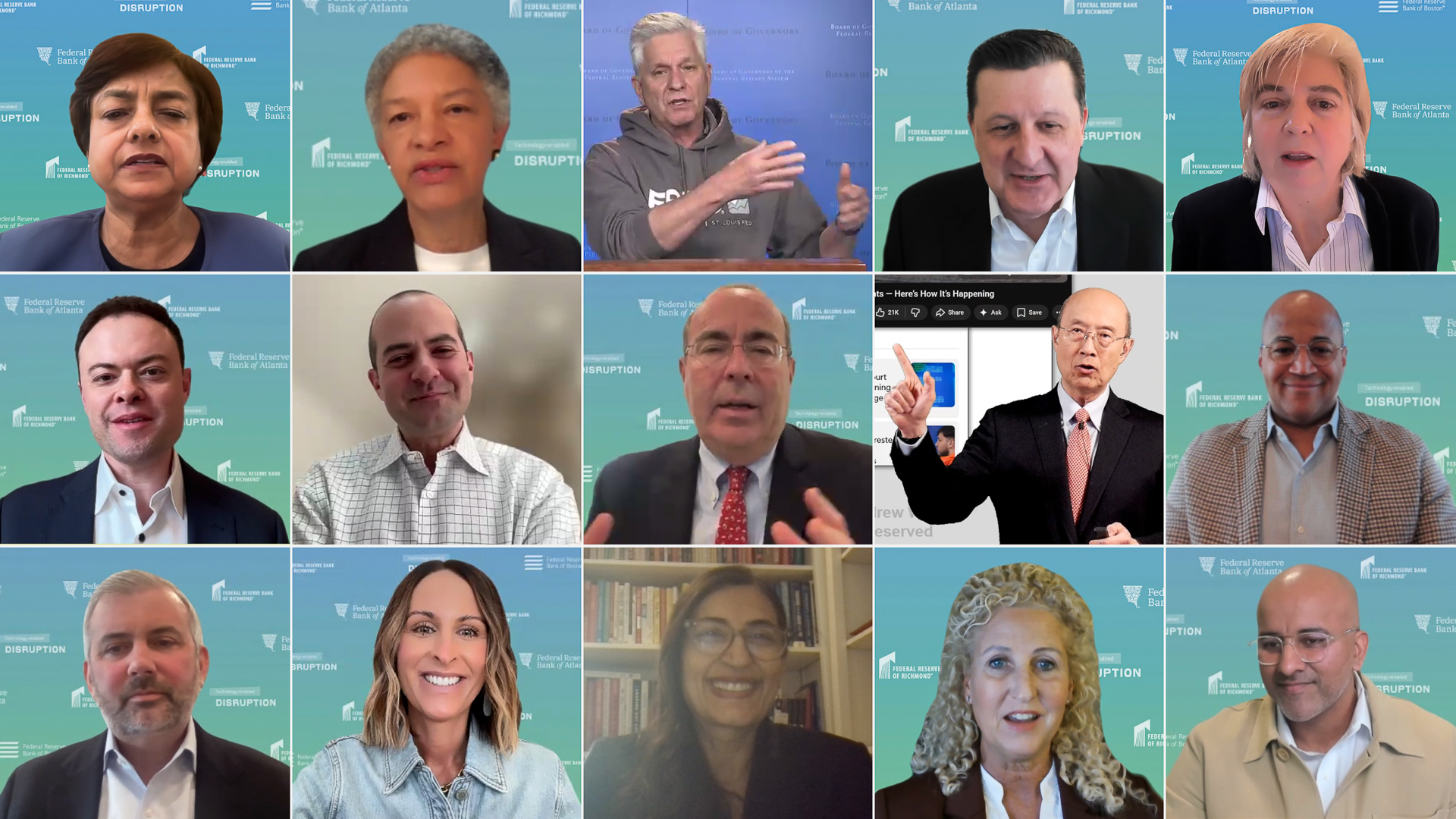
Federal Reserve Governor Christopher Waller said artificial intelligence will significantly influence the Fed’s daily work, including in payments and financial services.
AI’s overall impact is going to be massive, he added.
“I’ve seen the birth of space exploration, the rise of the personal computer, the explosion of the internet and then smartphones,” Waller said. “None match the potential that AI has in changing our lives and doing so at breathtaking speed.”
Waller made his remarks during his keynote address at the 2026 Technology-Enabled Disruption Conference: Shaping the Future of Finance and Payments.
The virtual event on Feb. 24 explored how emerging tech innovations are impacting businesses, workers, and consumers, as well as the overall economy. It was hosted by the Boston, Atlanta, and Richmond Federal Reserve Banks.
Waller said it’s imperative that the Fed, which plays an important role in the U.S. and global financial systems, keeps pace with the private sector to deliver effective and reliable services. To do so, the 12 Reserve Banks are collaborating to innovate and use new technology more efficiently, he said.
At the same time, Waller said the Fed must act responsibly and cannot “break things and ask for forgiveness.” He added that its goal in adopting new technologies isn’t novelty, it’s utility.
“We won't get a clear signal when AI moves from rapid progress to truly systemic impact,” he said. “But waiting for perfect clarity isn't a strategy. If we want to be ready when that moment comes, the work has to start now.”
Collins: Tech disruption affects inflation and employment
Boston Fed President Susan M. Collins said in her opening remarks that technology-enabled disruption can influence productivity, employment, inflation, and the financial system’s resilience.
“Understanding these dynamics helps inform how we think about the Fed’s dual mandate of maximum employment and price stability,” she said. “And it relates directly to the Boston Fed’s overarching mission: a vibrant economy that works for everyone.”
Collins said a wide range of views is needed to fully understand technology-enabled disruption. That’s why the conference included leaders from a variety of fields, including banking, tech, research, and policy. Collins later discussed AI’s role in the U.S. economy with Richmond Fed President Tom Barkin.
In the conference’s first panel, banking and fintech leaders discussed how new technologies like AI can help companies improve customer service, product management, and routine back-office processes. But they emphasized that human judgement and responsible leadership remain critical to a company’s success.
“Information alone doesn’t generate insights, and it’s insights that drive management decision-making. … Accountability has to stay with people,” said Dante Disparte, an executive at payments tech company Circle.
Swati Bhatia, who leads retail banking for Santander Bank, said AI is not about replacing existing employees but giving them additional tools.
“What we need in the existing workforce is a change in the mindset,” she said. “(The pace of change) is very fast today, and it’s only going to become faster.”
New payment tech could benefit businesses, workers
Business leaders also discussed how new technologies, such as instant payments and cryptocurrency, could benefit businesses and workers.
Boston Fed Executive Vice President Nick Stanescu said that, for example, the Federal Reserve’s FedNow instant payments service moves money between accounts in seconds rather than days. It also allows users to request payments. In theory, these tools could help employees who are living paycheck to paycheck receive their wages faster.
But Saurav Sharma, a fintech vice president at financial software company Intuit, said millions of employers still prefer to use physical checks rather than services that support payment requests or “demand deposit,” which would allow employees to receive their pay instantly, at any time. By using paper checks, employers can control the earliest possible day that the money can leave their account.
This can result in some workers paying high fees at check-cashing businesses to access their wages as quickly as possible, he said. Sharma added there’s opportunity for financial institutions who can meet these competing needs.
“Our system is still a bit antiquated when it comes to (workers) accessing the money they’ve earned, and that’s where the opportunity lies,” he said.
Researchers: Fintech lending, AI finance tools come with risks
Tech researchers said that some recent advancements, like the use of “digital footprints” and AI in lending services, could increase access to financial services. But they warned it could also result in greater inequality and more financial exploitation.
Duke University professor Manju Puri explored how these digital footprints – detailed, personal data collected by companies about a person’s online activities – can better predict whether that individual will default on their debts than a credit score alone.
She also said that fintech companies are now providing credit to people who otherwise would not have had access to it through traditional lenders like banks. However, the researchers emphasized that fintech companies are far less regulated than traditional banks and might hit financially vulnerable people with high fees.
MIT professor Andrew Lo, who directs the school’s Laboratory of Financial Engineering, said that the financial advice offered by AI chatbots, or “large language models,” has become more sophisticated. But he emphasized that this advice is not fiduciary – meaning AI tools are not legally obligated to act in the user’s best financial interests – and it should not be followed blindly.
Lo added that financial scams are becoming tougher to avoid, as criminals are also taking advantage of new tools and fooling even tech-savvy people.
“The upside for AI and technology is the democratization of finance,” he said. “One downside is cyber-risk. … It’s no longer about hacking into banks, but about hacking into humans.”
Watch the full conference recording on bostonfed.org.
Listen to the Boston Fed’s podcast episodes on several issues discussed, including AI’s role in credit, decentralized finance, and how fintech is disrupting financial services.
Media Inquiries?
Contact our media relations team. We connect journalists with Boston Fed economists, researchers, and leadership and a variety of other resources.

 About the Authors
Amanda Blanco is a member of the communications team at the Federal Reserve Bank of Boston.
Email: Amanda.Blanco@bos.frb.org
Site Topics
Keywords
- AI ,
- FedNow ,
- Instant Payments ,
- Financial Technology ,
- Workforce